The global push toward circular manufacturing has fundamentally changed how rubber, plastic, and coatings industries source their raw materials. At the center of this transformation sits one of the most economically and environmentally significant innovations of the decade: recovered carbon black (rCB). For tyre manufacturers, rubber compounders, and polymer producers facing volatile virgin carbon black prices, tightening sustainability mandates, and pressure from OEMs to decarbonize supply chains, recovered carbon black as a filler is no longer a niche alternative. It is a strategic material decision.
As a Hapur-based manufacturer of high-grade recovered carbon black, Absolute Green Carbon (a division of Absolute Green Polymers Pvt Ltd) works directly with rubber and tyre producers across India and international markets to supply consistent, performance-grade rCB derived from end-of-life tyre pyrolysis. This guide consolidates everything procurement teams, R&D engineers, and compounders need to understand about rCB as a filler, including its chemistry, applications, cost advantages, technical performance, and what to look for when sourcing it.
Whether you are evaluating rCB for the first time or benchmarking suppliers, this comprehensive resource is built to help you make informed, data-backed decisions.
What Is Recovered Carbon Black as a Filler?
Recovered carbon black (rCB) as a filler is a sustainable, reinforcing carbonaceous material produced from the pyrolysis of end-of-life tyres and rubber waste. It is used in rubber, plastic, coating, and ink formulations as a partial or full replacement for virgin carbon black (vCB), offering comparable reinforcement, lower carbon emissions, and significant cost savings for industrial manufacturers.
What Is Recovered Carbon Black (rCB)?
Recovered carbon black is a fine, black powder produced by thermally decomposing end-of-life tyres (ELTs) and other rubber-based waste in an oxygen-controlled environment, a process known as pyrolysis. The resulting solid char is then processed, milled, and often pelletized to produce a material with properties closely resembling virgin carbon black grades such as N550, N660, and N772.
Unlike virgin carbon black, which is manufactured from fossil-fuel feedstocks (typically heavy petroleum oil or coal tar) through the furnace process, rCB recovers the carbon originally embedded in tyres during their first production cycle. This gives rCB a fundamentally different sustainability profile and a substantially lower carbon footprint.
Key Characteristics of rCB
- Carbon content typically ranging from 80% to 90%
- Ash content between 8% and 18% (depending on feedstock and process)
- Surface area generally between 30 and 90 m²/g
- Particle size distribution comparable to semi-reinforcing carbon blacks
- Available in powder, pelletized, and micronized forms
The growing global production capacity of rCB, projected to exceed several million tonnes annually by 2030, reflects how rapidly this material is being absorbed into mainstream industrial supply chains.
How Recovered Carbon Black Works as a Filler
In rubber and polymer compounding, a filler is a particulate material added to a matrix to modify mechanical, thermal, or electrical properties or to reduce cost. Carbon black has historically been the dominant reinforcing filler in the rubber industry because of its ability to enhance tensile strength, abrasion resistance, tear strength, and durability.
Recovered carbon black functions through the same fundamental mechanisms as virgin carbon black:
- Reinforcement through filler-polymer interaction — rCB particles bond with rubber chains, restricting molecular movement and increasing stiffness and strength.
- Aggregate and agglomerate structure — the morphology of rCB aggregates influences modulus, hysteresis, and dispersion behavior.
- Surface activity — functional groups on the rCB surface drive chemical interaction with the polymer matrix.
- Stress distribution — well-dispersed rCB distributes mechanical stress across the rubber network, improving fatigue life.
Because rCB is derived from tyre rubber that already contained vCB, it preserves a portion of the original reinforcing structure. With proper post-processing such as milling, demineralization, and pelletization, rCB can be engineered to perform as a direct replacement for semi-reinforcing carbon black grades or as a partial substitute for higher-reinforcing grades.
Manufacturing Process Overview: From Waste Tyres to Industrial Filler
The journey from a discarded tyre to a high-performance industrial filler involves a sequence of carefully controlled stages. Understanding this process is critical for procurement teams evaluating rCB quality.
Stage 1: Feedstock Collection and Preparation
End-of-life tyres are collected from authorized aggregators, fleet operators, and tyre dealers. The tyres are then shredded into smaller chips, with steel wire and textile fibers separated through magnetic and gravimetric processes.
Stage 2: Pyrolysis
The clean rubber chips are fed into a pyrolysis reactor and heated to temperatures typically between 400°C and 600°C in the absence of oxygen. This thermal decomposition breaks the rubber down into three main outputs:
- Pyrolysis oil (used as industrial fuel or refined further)
- Pyrolysis gas (often recycled to power the reactor)
- Carbon char (the precursor to recovered carbon black)
Stage 3: Char Processing
The raw char undergoes:
- Magnetic separation to remove residual steel
- Grinding and milling to achieve target particle size
- Demineralization (in some operations) to reduce ash content
- Sieving and classification
Stage 4: Pelletization and Packaging
To make the material suitable for industrial use, especially in automated rubber mixing lines, the milled rCB is pelletized using wet or dry pelletization techniques. Final products are packaged in jumbo bags, 25 kg bags, or bulk containers based on customer specifications.
At Absolute Green Carbon’s Hapur facility, this process is conducted under controlled quality protocols designed to deliver consistent batch-to-batch performance, which is one of the most critical requirements for industrial buyers.
Applications of Recovered Carbon Black
The versatility of rCB has expanded rapidly as compounders and formulators validate its performance across a growing range of industries.
1. Rubber and Tyre Industry
The rubber industry remains the largest consumer of rCB. Applications include:
- Non-tread tyre components such as sidewalls, inner liners, bead fillers, and carcass plies
- Conveyor belts
- Hoses and tubes
- Automotive rubber parts (engine mounts, bushings, weather seals)
- Industrial rubber goods
- Footwear soles
- Rubber mats and flooring
In tyre manufacturing, rCB is increasingly used in semi-reinforcing positions where the demand for ultra-high abrasion resistance is lower, allowing cost savings without compromising service life.
2. Plastics and Polymer Compounds
rCB is incorporated into:
- Polyethylene (PE) and polypropylene (PP) compounds
- Masterbatches for color and conductivity
- Pipes, geomembranes, and agricultural films
- Engineering plastics requiring UV protection or pigmentation
3. Coatings, Inks, and Paints
After additional refinement, rCB can serve as a pigment or functional additive in:
- Industrial coatings
- Asphalt and bitumen modification
- Printing inks
- Sealants and adhesives
4. Construction and Infrastructure Materials
Emerging applications include:
- Modified asphalt for road construction
- Concrete additives for darker, more durable surfaces
- Roofing membranes
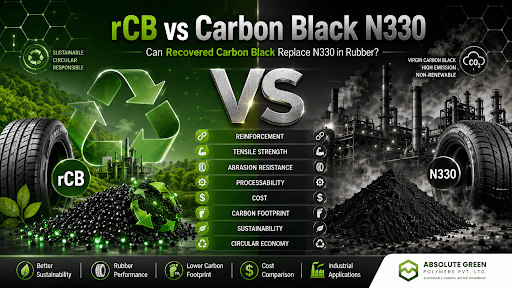
Recovered Carbon Black vs Virgin Carbon Black: A Comparison
For procurement teams evaluating material substitution, a side-by-side comparison clarifies where rCB fits in the supply chain.
| Parameter | Recovered Carbon Black (rCB) | Virgin Carbon Black (vCB) |
| Feedstock | End-of-life tyres and rubber waste | Petroleum oil or coal tar |
| Carbon Footprint | ~80% lower CO₂ emissions | High emissions intensity |
| Carbon Content | 80–90% | 95–99% |
| Ash Content | 8–18% | Less than 1% |
| Surface Area | 30–90 m²/g | 7–150+ m²/g (grade-dependent) |
| Reinforcement Level | Comparable to N550–N772 grades | Spans N100 to N900 series |
| Price | 30–50% lower than vCB | Market-volatile, oil-linked |
| Sustainability Credentials | Circular economy material | Linear fossil-based material |
| Best Suited For | Semi-reinforcing applications, masterbatches, non-tread components | Reinforcing tread compounds, high-performance applications |
This comparison highlights why rCB is rarely positioned as a one-to-one replacement for every vCB grade. Instead, it is deployed strategically where its performance matches the application requirement, often delivering identical end-product quality at a significantly lower cost and carbon impact.
Cost Savings and Sustainability Benefits
The business case for rCB rests on two pillars: economics and environmental performance.
Cost Advantages
- Lower unit price — rCB typically costs 30% to 50% less than equivalent virgin carbon black grades, depending on market conditions.
- Insulation from oil price volatility — because rCB is not directly tied to crude oil markets, it offers price stability that vCB cannot.
- Reduced raw material spend — even a 10% to 20% replacement of vCB with rCB in a compound formulation can deliver measurable margin improvements at scale.
- Lower logistics costs in regional sourcing — buying rCB from domestic manufacturers like Absolute Green Carbon reduces import dependence and shipping expenses.
Sustainability Advantages
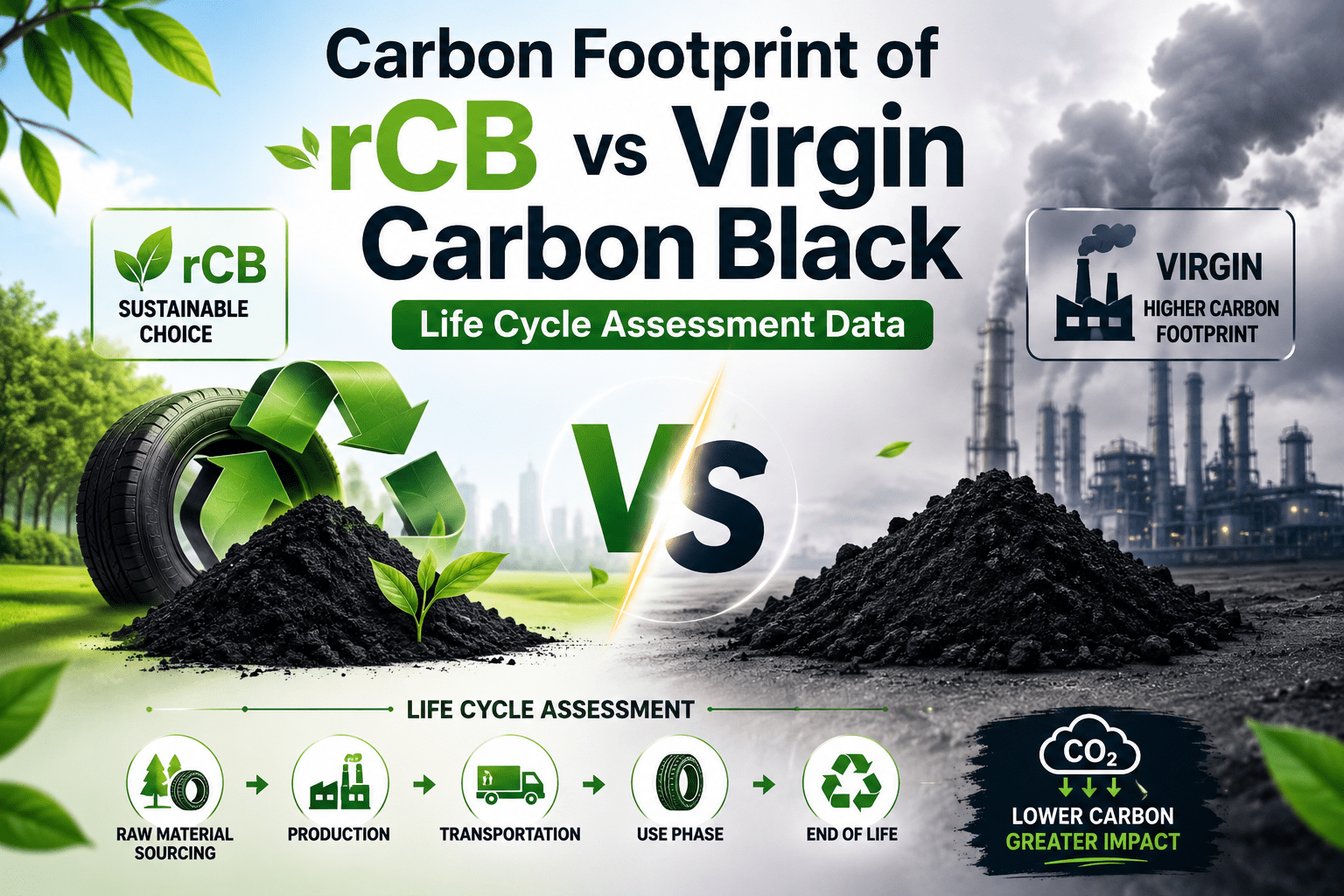
- Carbon footprint reduction — replacing one tonne of virgin carbon black with rCB can avoid approximately 2 to 3 tonnes of CO₂ equivalent emissions.
- Tyre waste diversion — every tonne of rCB produced diverts roughly 2.5 to 3 tonnes of waste tyres from landfills and incineration.
- Circular economy contribution — rCB closes the loop on rubber materials, aligning with global Extended Producer Responsibility (EPR) frameworks.
- ESG and reporting benefits — companies using rCB can demonstrate measurable Scope 3 emissions reductions to investors, OEM customers, and regulators.
For tyre manufacturers and rubber goods producers navigating EU CBAM, India’s EPR mandates for waste tyres, and OEM decarbonization targets, rCB is becoming a compliance enabler, not just a cost-saving lever.
Performance and Technical Properties of rCB
A common concern among first-time buyers is whether rCB can deliver the technical performance their compounds require. Modern rCB grades, particularly those produced under controlled industrial processes, have demonstrated strong performance across key metrics.
Typical Technical Specifications
- Iodine adsorption number: 40–80 mg/g
- Oil absorption number (OAN): 70–130 ml/100g
- Volatile matter: less than 2%
- Moisture content: less than 1%
- pH: 7–10
- Pour density: 280–450 kg/m³ (pelletized form)
Performance in Rubber Compounds
When properly formulated, rCB-containing compounds can achieve:
- Tensile strength within 85% to 95% of vCB equivalents
- Comparable elongation at break
- Similar abrasion resistance in semi-reinforcing applications
- Acceptable Mooney viscosity and cure characteristics
- Strong rebound and dynamic performance for non-tread applications
Formulation adjustments such as silane coupling agents, antidegradants, and optimized cure systems can further close the performance gap with vCB, especially in demanding applications.
Industrial Use Cases Where rCB Excels
Practical industry adoption demonstrates where rCB delivers the strongest return.
- Truck and bus tyre sidewalls — high volume, semi-reinforcing requirement, ideal rCB application
- Off-the-road (OTR) tyre components — non-critical sections benefit from cost reduction
- Conveyor belt cover compounds — particularly in mining and bulk material handling
- Automotive rubber components — bushings, mounts, seals where reinforcement demand is moderate
- Footwear sole compounds — color, density, and cost benefits align well
- PVC and HDPE pipe compounds — UV protection and pigmentation
- Plastic masterbatches — cost-effective black coloring for non-critical applications
- Industrial flooring and mats — bulk filler with adequate reinforcement
Industry Challenges and Quality Concerns
Honest acknowledgment of rCB’s challenges is essential for any technical decision-maker. The industry continues to evolve in addressing these issues.
Batch-to-Batch Variability
Because feedstock (waste tyres) can vary by origin, age, and composition, rCB properties can fluctuate. Leading manufacturers like Absolute Green Carbon address this through:
- Standardized feedstock sorting
- Tight process controls during pyrolysis
- Blending strategies to ensure specification consistency
- In-house quality testing at every batch
Ash Content
Higher ash content than vCB can affect dispersion and electrical properties in some applications. Demineralization and advanced processing technologies are progressively reducing this gap.
Dispersion and Mixing
rCB particles may behave differently during mixing compared to vCB. Compounders often need to adjust mixing protocols, but most modern internal mixers and Banbury equipment handle rCB effectively with minor process tuning.
Market Standardization
The industry is moving toward standardized rCB grade classifications, with ASTM D8178 and emerging international standards bringing greater clarity to specification language and quality benchmarks.
Perception and Adoption Barriers
Some buyers still associate “recycled” with “lower quality.” Education, performance data sharing, and pilot trials are gradually changing this perception, especially as global tyre manufacturers publicly commit to rCB incorporation targets.
Future Market Trends in Recovered Carbon Black
The rCB industry is on a strong growth trajectory, driven by converging policy, sustainability, and economic forces.
Key Trends Shaping the Industry
- OEM commitments — major tyre manufacturers have publicly committed to incorporating significant percentages of recovered or sustainable materials in their products by 2030 and beyond.
- Regulatory pressure — Extended Producer Responsibility (EPR) regulations in India, EU, and other jurisdictions are mandating tyre recycling and creating structural demand for rCB.
- Carbon pricing mechanisms — instruments like the EU Carbon Border Adjustment Mechanism (CBAM) make low-carbon materials more competitive.
- Capacity expansion — global rCB production capacity is expanding rapidly, with new plants commissioned across India, Europe, North America, and Southeast Asia.
- Technology advancement — next-generation pyrolysis, post-processing, and surface modification technologies are pushing rCB closer to high-reinforcing vCB grades.
- Standardization — industry bodies are developing universal specifications, improving buyer confidence.
- Integration with sustainable tyre programs — rCB is becoming a cornerstone of “sustainable tyre” marketing claims and material disclosures.
India, with its large waste tyre generation base and growing manufacturing sector, is positioned to become one of the world’s most important rCB production and consumption hubs.
Buying Considerations: How to Choose the Right rCB Supplier
For procurement teams, supplier selection determines whether rCB delivers its full promise. Use this checklist when evaluating suppliers.
Technical Criteria
- Consistent batch-to-batch specifications backed by test data
- Clear product data sheets with iodine number, OAN, ash, moisture, and volatile content
- Availability in required form (powder, pellet, micronized)
- Application-specific grades aligned with your end use
Operational Criteria
- Production capacity to meet your volume requirements
- Reliable lead times and logistics
- Quality management certifications
- Traceability of feedstock and process
Commercial Criteria
- Competitive pricing relative to vCB equivalents
- Flexible packaging and delivery terms
- Long-term supply agreements
- Domestic versus import considerations
Sustainability Criteria
- Verified carbon footprint data
- Compliance with EPR regulations
- Transparent reporting that supports your own ESG disclosures
Absolute Green Carbon, based in Hapur (Uttar Pradesh, India), supports industrial buyers across these criteria with technical documentation, sample programs, and capacity-backed commercial agreements suited to rubber, tyre, and polymer manufacturers across India and global markets.
Frequently Asked Questions
Recovered carbon black is used primarily as a reinforcing filler in rubber compounds for tyres, conveyor belts, hoses, and industrial rubber goods. It is also used in plastic compounds, masterbatches, coatings, inks, asphalt modification, and construction materials, serving as a sustainable substitute for virgin carbon black.
Recovered carbon black performs comparably to semi-reinforcing virgin carbon black grades such as N550, N660, and N772. For non-tread tyre components, industrial rubber, and plastic applications, properly produced rCB delivers similar mechanical performance at lower cost and significantly reduced carbon emissions. It is not a direct replacement for high-reinforcing tread-grade vCB.
Recovered carbon black is produced through the pyrolysis of end-of-life tyres. Shredded tyre rubber is heated to 400–600°C in an oxygen-free reactor, breaking it down into oil, gas, and a carbon-rich char. The char is then milled, demineralized in some processes, and pelletized into a finished industrial filler.
The tyre and rubber industry is the largest consumer, followed by plastics and polymer compounding, paints and coatings, printing inks, asphalt and road construction, footwear, conveyor systems, and a growing range of engineered industrial products.
Recovered carbon black is typically 30% to 50% less expensive than equivalent virgin carbon black grades. The exact differential depends on rCB grade, virgin carbon black market conditions (which track crude oil prices), region, and order volumes.
Yes. rCB has a carbon footprint approximately 80% lower than virgin carbon black. Every tonne of rCB produced diverts roughly 2.5 to 3 tonnes of waste tyres from landfills and avoids 2 to 3 tonnes of CO₂ equivalent emissions, making it a verified circular economy material.
Virgin carbon black is manufactured from fossil-fuel feedstocks (petroleum oil or coal tar) through the furnace process. Recovered carbon black is produced from end-of-life tyres through pyrolysis. Both serve as reinforcing fillers, but rCB has a much lower environmental footprint and typically contains more residual ash.
Yes. Recovered carbon black is widely used in non-tread tyre components such as sidewalls, inner liners, bead fillers, and carcass plies. Most leading global tyre manufacturers have announced rCB incorporation programs as part of their sustainability strategies.
ASTM D8178 is the primary international standard providing terminology and classification guidance for recovered carbon black. It establishes the framework for specifying, testing, and trading rCB in commercial markets.
Absolute Green Carbon, headquartered in Hapur, Uttar Pradesh, manufactures and supplies recovered carbon black to rubber, tyre, and polymer manufacturers across India and international markets. Buyers can request technical data sheets, samples, and commercial quotations directly.
Partner with Absolute Green Carbon for Industrial-Grade rCB Supply
If your manufacturing operation is evaluating recovered carbon black as a filler, the next step is a technical conversation grounded in your specific application, volume requirements, and quality specifications.
Absolute Green Carbon, a division of Absolute Green Polymers Pvt Ltd, operates from Hapur, India, supplying consistent, performance-grade recovered carbon black to rubber compounders, tyre manufacturers, polymer processors, and industrial product makers. Our team supports buyers with product data sheets, sample evaluations, dispersion guidance, and capacity-backed commercial agreements.
To request a technical specification sheet, sample, or quotation for your application, contact the Absolute Green Carbon procurement and technical team for a direct consultation. Industrial buyers, distributors, and OEMs evaluating sustainable filler partnerships are welcome to initiate inquiries.