As India’s vehicle fleet grows, so does the volume of tyres reaching end-of-life every year. With over 1.2 million metric tonnes of scrap tyres generated annually, end-of-life tyre (ELT) recycling has moved from an environmental concern to an operational priority for manufacturers, fleet operators, and policy teams alike.
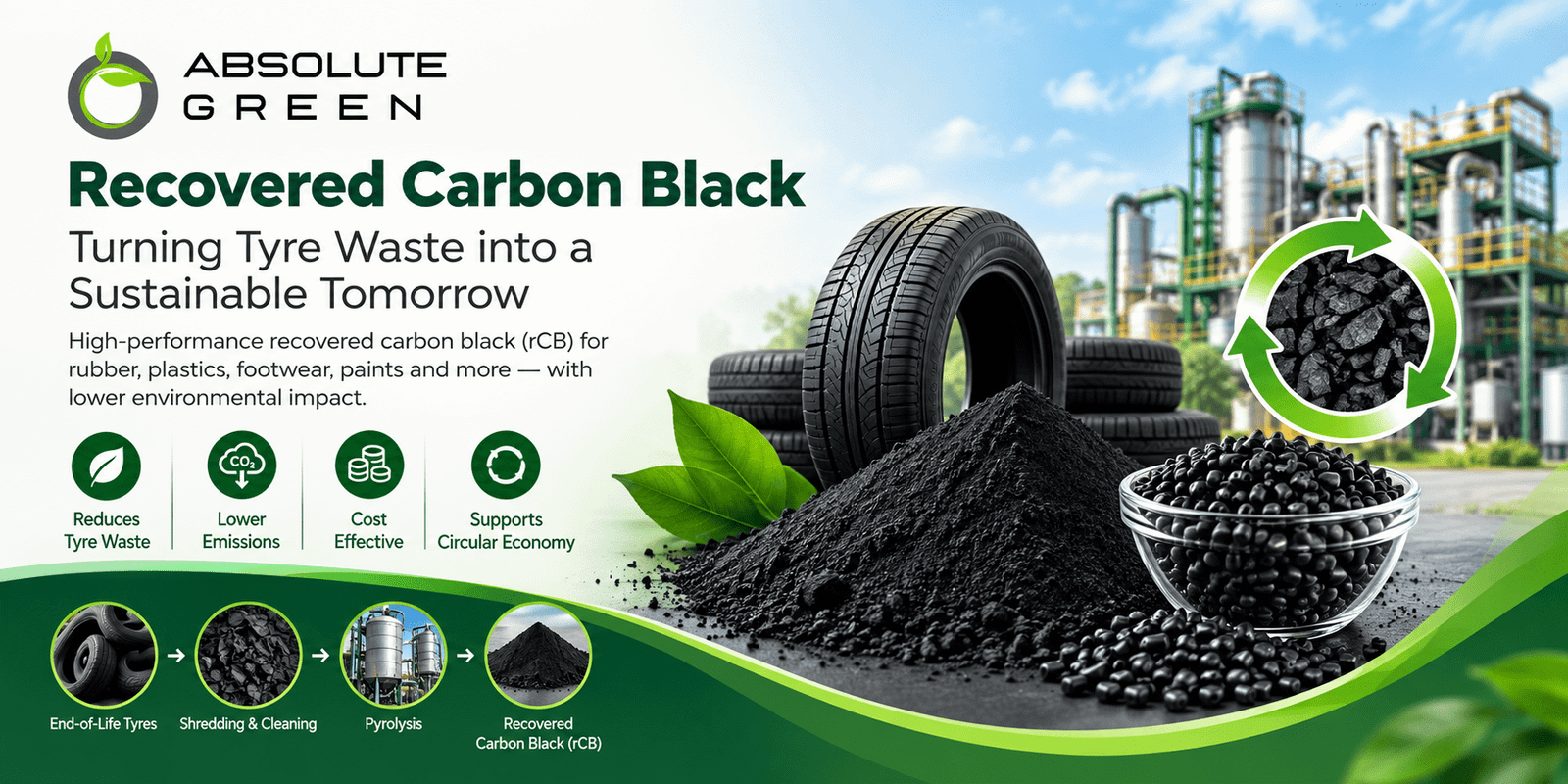
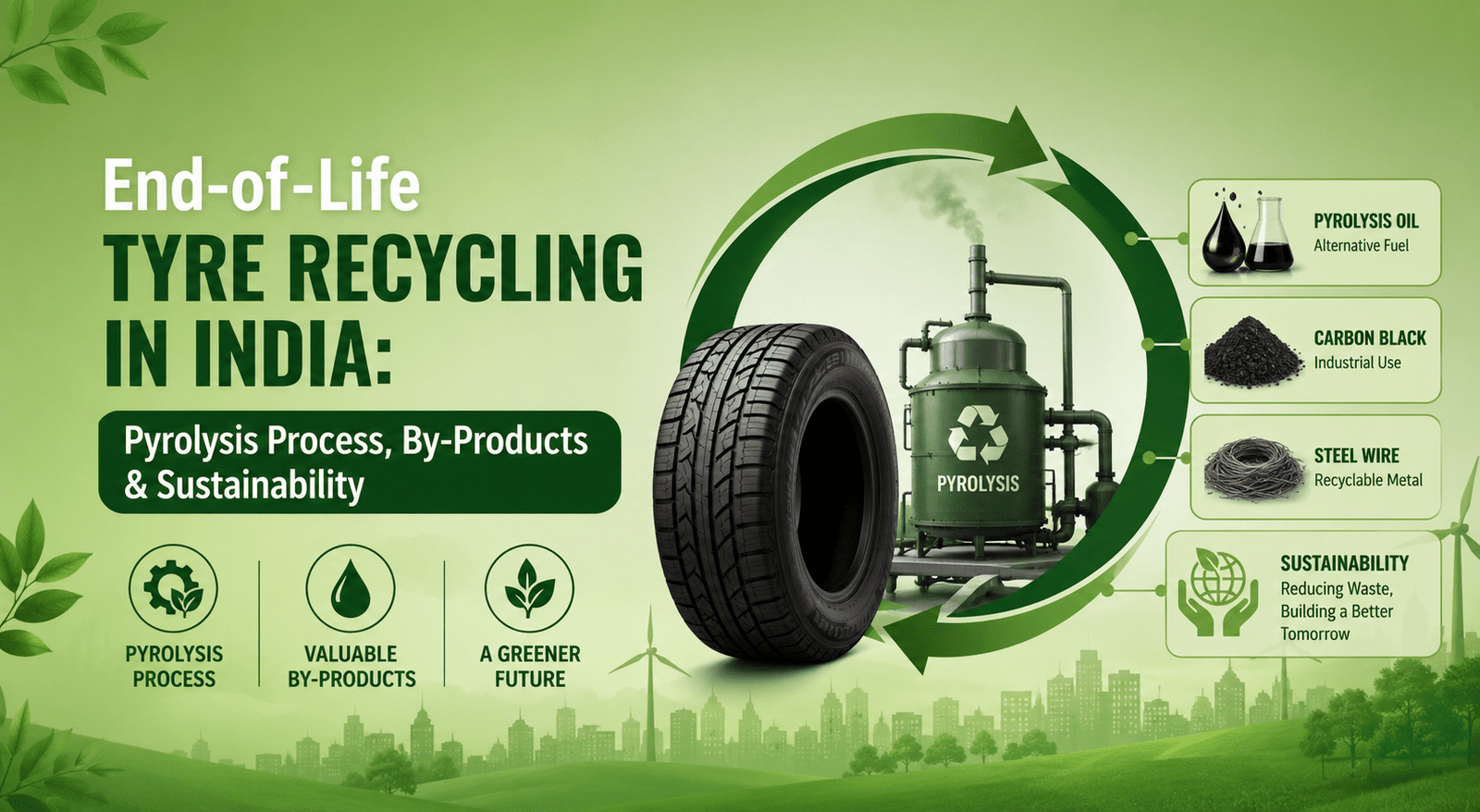
But responsible ELT recycling is not simply about collection — it is about what happens next. Advanced pyrolysis processing converts waste tyres into recovered carbon black (rCB), pyrolysis oil, steel wire, and syngas, each with measurable commercial value. Understanding this process — and the compliance frameworks that govern it — is essential for anyone sourcing, procuring, or reporting on sustainable tyre disposal in India.
So what exactly does responsible ELT recycling look like? And how can businesses verify that their recycling partners are operating within India’s regulatory and quality frameworks?
India’s Tyre Waste Crisis: Scale, Impact & Urgency
India is the world’s third-largest tyre producer. The Automotive Tyre Manufacturers’ Association (ATMA) estimates that approximately 112 million tyres reach end-of-life every year — a figure projected to double by 2035 as passenger-vehicle and commercial-vehicle registrations continue to accelerate.
Despite this scale, India’s formal ELT processing infrastructure remains underdeveloped. Historically, most waste tyres met one of three fates:
- Illegal dumping in open fields, riverbeds, and municipal landfills — creating fire hazards and disease vectors.
- Uncontrolled burning for fuel in brick kilns and informal workshops — releasing dioxins, furans, and black carbon.
- Informal grinding by roadside operators with no emissions controls and minimal material recovery.
None of these pathways recovers the value locked inside the tyre. All three create documented environmental and public-health harm.
The Economic Case for Proper ELT Recycling
Viewed differently, India’s tyre waste problem is also an industrial opportunity. Advanced pyrolysis of one tonne of waste tyres yields approximately:
- 350–450 litres of pyrolysis oil
- 300–380 kg of recovered carbon black (rCB)
- 150–180 kg of clean steel wire
- 80–150 cubic metres of non-condensable syngas
At current market rates, the combined value of these outputs can exceed ₹15,000–₹20,000 per tonne of input — making responsible recycling economically viable without subsidy, at sufficient scale.
What Are End-of-Life Tyres (ELTs)? Definition & Categories
An end-of-life tyre (ELT) is any tyre that is no longer suitable for its original purpose on a vehicle and cannot be retreaded or reused in its existing form. The term is the internationally accepted standard designation, used by the European Tyre & Rubber Manufacturers’ Association (ETRMA), the Global Platform for Sustainable Consumption and Production, and now formally adopted in India’s Extended Producer Responsibility (EPR) framework under the Hazardous and Other Wastes (Management and Transboundary Movement) Amendment Rules.
ELT Classification in India
Indian regulatory and industry practice recognises the following ELT sub-categories:
- Tyres from private cars, taxis, and light commercial vehicles up to 3.5 tonnes GVW. These are the highest-volume category and most homogeneous in composition, making them preferred feedstock for pyrolysis. Passenger Car Tyres (PCTs):
- Large-format tyres from heavy commercial vehicles. TBRs contain a higher proportion of steel cord and natural rubber, yielding more steel wire per tonne but requiring larger shredding equipment. Truck & Bus Radials (TBRs):
- Mining, construction, and agricultural equipment tyres. These are extremely large and contain specialised rubber compounds; processing requires dedicated infrastructure. Off-the-Road (OTR) Tyres:
- Motorcycle and scooter tyres. These tend to have lower steel content and higher synthetic rubber fractions. Two-Wheeler Tyres:
- Casings that have reached the end of their retreading potential and cannot support further buffing and application. Retreaded Tyre Casings (Post-Retread):
Material Composition of a Typical Passenger Car Tyre
| Material Component | Approx. % by Weight | Primary Source |
| Natural & synthetic rubber | 40–45% | Latex / petrochemical |
| Carbon black (virgin) | 25–28% | Petrochemical |
| Steel wire & cord | 15–18% | High-tensile steel |
| Textile fibres | 5–6% | Polyester / nylon |
| Additives (sulphur, ZnO, etc.) | 4–6% | Chemical compounding |
ELT Collection & Authorised Channel Process in India
Effective ELT recycling begins before any tyre enters a shredder or pyrolysis reactor. A robust, documented collection chain is essential for regulatory compliance, EPR credit generation, and — increasingly — ESG reporting by tyre manufacturers and fleet operators.
The Formal Collection Ecosystem
India’s formal ELT collection chain involves four principal stakeholder groups:
- Under the EPR rules notified in 2016 and strengthened by CPCB guidance in subsequent years, tyre manufacturers (Bridgestone, MRF, Apollo, CEAT, JK, TVS, Goodyear, and others) bear legal responsibility for a defined fraction of ELT generated by the tyres they place on the market. They fulfil this through direct collection programmes or by purchasing EPR credits from authorised recyclers. Producers & Brand Owners:
- Registered scrap dealers, tyre retreaders, petrol stations, and fleet depots serve as first-mile collection points. CPCB authorisation requires infrastructure for segregated storage and a documented dispatch process to prevent diversion to illegal burning or landfill. Authorised Collection Centres:
- Intermediary businesses that consolidate ELT volumes from multiple collection points and ensure logistically efficient delivery to large-scale processors. Aggregators & Traders:
- CPCB-authorised facilities that perform the actual processing — shredding, crumbing, or pyrolysis — and issue EPR fulfilment certificates. Authorised Recyclers (PROs and standalone processors):
Documentation & Chain of Custody
A compliant ELT transaction requires: a Material Receipt Certificate (MRC) issued at each transfer point, vehicle weigh-bridge receipts, geotagged photographic evidence of collection, and a final Recycling / Processing Certificate issued by the authorised facility. This documentation chain is the foundation for EPR credit issuance under India’s regime.
Compliance Note: Sustainability managers should request full chain-of-custody documentation from any ELT recycler before onboarding them as an EPR fulfilment partner. Certificates without verifiable underlying documentation are a known compliance risk in the Indian market.
The Pyrolysis Process: Step-by-Step Breakdown
Pyrolysis — from the Greek pyr (fire) and lysis (separation) — is a thermochemical decomposition process that breaks down complex organic molecules in the absence of oxygen. Applied to waste tyres, it converts the rubber and other organic constituents into commercially valuable liquid fuel, gas, and a carbon-rich solid, while cleanly separating the embedded steel wire for direct recycling.
Below is a numbered HowTo breakdown of industrial tyre pyrolysis as practised in a best-in-class Indian facility.
Step 1: Pre-Processing & Feedstock Preparation
Incoming ELTs are weighed, visually inspected, and sorted by type (PCT, TBR, two-wheeler). Whole tyres are fed into a heavy-duty shredder — typically a single-shaft or double-shaft design — producing chips of approximately 50–100 mm. Oversized bead wire clusters are magnetically removed at this stage to protect reactor internals. The chips then pass through a secondary granulator producing 10–30 mm particles and a magnetic separator that recovers residual steel and textile fibre.
Step 2: Drying & Moisture Control
Granulated tyre rubber retains surface moisture from washing and from ambient humidity. Excess moisture in the reactor reduces thermal efficiency and can cause pressure surges. A rotary drum dryer or infrared pre-heater reduces moisture content to below 1% w/w before the material is conveyed to the feed hopper.
Step 3: Reactor Loading & Inert Atmosphere Purging
In batch reactors (the most common configuration in India), dried tyre chips are loaded into the sealed cylindrical reactor vessel — capacities range from 5 to 15 tonnes per batch. Before heating commences, the reactor is purged with nitrogen to create an oxygen-free environment. This is a critical safety step: any residual oxygen at pyrolysis temperatures would cause combustion rather than controlled thermal cracking, creating fire and explosion risk.
Step 4: Thermal Cracking (Core Pyrolysis Stage)
The reactor is heated externally — typically using a gas burner fuelled partly by the syngas produced in the process itself. Temperature is ramped from ambient to the target pyrolysis range of 380–550°C over a controlled heating profile of 2–4 hours. Within this temperature window, the long-chain rubber polymers break down into shorter hydrocarbon chains. The cracked vapours rise from the reactor and are carried by the nitrogen carrier gas into the condenser train.
Step 5: Vapour Condensation & Pyrolysis Oil Recovery
The hot vapour stream passes through a series of condensers — typically three stages, operating at progressively lower temperatures (90°C, 40°C, ambient). The condensable fraction (C8–C20 hydrocarbons) liquefies as pyrolysis oil. Non-condensable light gases (C1–C4 hydrocarbons: methane, ethane, propane, butane) remain gaseous and are collected in a gas holder for use as process fuel or flaring in a controlled afterburner. Condensed oil is collected in sealed tanks, tested for quality parameters, and pumped to a product storage area.
Step 6: Carbon Black Extraction & Post-Processing
Once the reactor temperature falls below 200°C, the residual solid — primarily carbon black with fine steel fragments — is discharged by rotating the reactor drum or via a screw conveyor. This crude rCB (recovered carbon black) is magnetically cleaned to remove residual steel, then subjected to grinding and classification to achieve the target particle size distribution (typically D50 of 30–80 µm). Thermal treatment or activation may be applied to reduce the volatile content and improve reinforcing properties.
Step 7: Steel Wire Recovery
Magnetic separation at the discharge conveys separates embedded steel wire bales and fine steel particles from the carbon residue. The steel is baled, weighed, and dispatched to steel re-rollers or electric arc furnace (EAF) operators as clean scrap.
Step 8: Emissions Treatment & Compliance Monitoring
The non-condensable syngas that is not used as process fuel is directed to a thermal afterburner operating above 850°C to destroy residual VOCs and dioxin precursors. Flue gases from the burner pass through a wet scrubber and activated carbon filter before discharge at a monitored stack. Real-time CEMS (Continuous Emission Monitoring Systems) log particulate matter, SOx, NOx, CO, and HCl, with data transmitted to the State Pollution Control Board’s server.
Step 9: Quality Testing, Batch Documentation & Dispatch
Each batch of pyrolysis oil is tested for density, flash point, viscosity, sulphur content, and calorific value per IS/ASTM standards. rCB is tested for iodine absorption number, DBP absorption, ash content, and surface area. Test certificates accompany every dispatch consignment, forming the product quality record required for EPR credit issuance and customer acceptance.
Pyrolysis By-Products: rCB, Pyro Oil, Steel Wire & Syngas
The economic and environmental case for pyrolysis rests on the quality and marketability of its four primary output streams. Understanding these by-products — their composition, applications, and quality benchmarks — is essential for procurement managers evaluating supplier credibility.
1. Recovered Carbon Black (rCB)
rCB is typically the highest-value and most strategically significant output of tyre pyrolysis. Virgin carbon black (vCB), produced by incomplete combustion of oil or natural gas, is a critical reinforcing filler in rubber compounds, a pigment in inks and coatings, and a conductive additive in battery electrodes. Global vCB production exceeds 14 million tonnes per year, almost all from fossil-fuel feedstocks.
rCB from tyre pyrolysis carries the carbon structure of the original vCB grade (predominantly N330/N550 equivalent) plus post-vulcanisation residues and inorganic ash. Leading processors apply:
- Thermal treatment (calcination at 600–900°C) to reduce volatile content to below 2.5%, meeting ASTM D1765 / ISO 6167 quality thresholds.
- Micronisation and air classification to achieve controlled particle size distribution (D50 10–60 µm) matching target application windows.
- Surface chemistry analysis (BET surface area, STSA, OAN/COAN) to certify reinforcing equivalence for rubber compounders.
Procurement Note: ASTM D8178-19 and the ICBA’s rCB Quality Specification Framework (2021) provide internationally recognised benchmarks for rCB traded between processors and compounders. Buyers should require compliance with these standards.
2. Pyrolysis Oil (Pyro Oil)
Pyro oil — also termed tyre-derived fuel oil (TDFO) or tyre pyrolysis liquid (TPL) — is a complex mixture of aliphatic and aromatic hydrocarbons with a boiling range broadly corresponding to diesel/fuel oil fractions. Typical properties:
- Calorific Value: 40–44 MJ/kg (comparable to heavy fuel oil, approximately 85% of diesel’s energy density).
- Density: 0.86–0.94 g/mL.
- Viscosity: 2–10 cSt at 40°C, making it pumpable without heating in most applications.
- Sulphur Content: 0.5–1.2% w/w — the primary quality constraint. Tyre pyrolysis oil is inherently higher in sulphur than fossil diesel, requiring blending or hydrodesulphurisation for road transport applications.
Principal markets in India include cement kilns (as coal/furnace oil substitute), ceramic and glass furnaces, asphalt mixing plants, and marine/industrial boilers. A small but growing segment undergoes further refining to produce low-sulphur diesel blendstock.
3. Steel Wire
Tyre steel is high-carbon, high-tensile spring steel (typically 0.65–0.85% C) that retains full metallurgical integrity through the pyrolysis process. Clean, magnetically separated tyre steel wire commands premium pricing as EAF scrap or rebar-grade feedstock. Processors recovering >95% metallic purity achieve pricing close to Shredded Scrap grade under the BIS/ISRI classification system.
4. Non-Condensable Syngas
The non-condensable gas fraction (C1–C4 hydrocarbons, primarily methane, ethylene, and propylene) has a calorific value of approximately 35–45 MJ/m³. Best-practice facilities route this gas directly to the external burner that heats the reactor, achieving near-energy-neutral operation — a significant improvement in both operating cost and lifecycle GHG intensity relative to externally-fuelled processes. Any surplus gas is flared in a controlled thermal oxidiser; direct atmospheric venting is prohibited under CPCB norms.
| By-Product | Yield per Tonne | Key Quality Metric | Primary Application |
| rCB | 300–380 kg | Iodine No. / BET surface area | Rubber compounding, inks, batteries |
| Pyrolysis Oil | 350–450 litres | Sulphur %, calorific value | Industrial fuel, diesel blendstock |
| Steel Wire | 150–180 kg | Metallic purity (%) | EAF scrap, rebar feedstock |
| Syngas | 80–150 m³ | Calorific value (MJ/m³) | Process heat, controlled flare |
Regulations & Compliance: Where to Learn More
India’s regulatory landscape for end-of-life tyres is evolving, and the details—EPR targets, authorisation procedures, amendment schedules—are updated periodically by CPCB and the Ministry of Environment, Forest and Climate Change (MoEFCC). Rather than reproduce those specifics here where they risk becoming outdated, we point you directly to the primary sources where the latest and most authoritative guidance is always available.
If you are a sustainability manager, policy researcher, or B2B buyer assessing a recycler’s compliance credentials, the resources below are the right starting points.
Recommended Resources: Use the links below to access the latest official guidance on ELT regulations, EPR obligations, and CPCB technical standards. These are primary sources — always more reliable than third-party summaries.
▸ CPCB — Hazardous & Other Wastes: Authorisation & Guidelines
https://cpcb.nic.in/hazardous-waste
Official portal for CPCB authorisation registers, technical guidelines for pyrolysis, and notified amendment documents.
▸ MoEFCC — Hazardous and Other Wastes Rules, 2016
https://moef.gov.in/en/division/environment-labs-division/hazardous-substances
The primary statutory instrument governing ELT classification, storage, transport, and processing in India.
▸ CPCB — Extended Producer Responsibility (EPR) Portal
https://eprnewportal.cpcb.gov.in
The mandatory digital portal for EPR credit registration, QR-code certificate verification, and producer compliance submissions.
▸ Bureau of Indian Standards (BIS) — Rubber & Tyre Standards
Technical standards relevant to tyre composition, retread quality, and processed rubber product specifications.
▸ ATMA — Automotive Tyre Manufacturers’ Association
Industry body publications on EPR framework updates, ELT volume data, and producer responsibility programme developments.
If you are evaluating Absolute Green Polymers Pvt. Ltd. as an ELT recycling or EPR fulfilment partner, we are happy to share our current CPCB authorisation certificate and EPR portal registration details directly. Contact our sustainability team to request a compliance documentation pack.
Environmental Benefits vs Landfill / Incineration
The environmental case for pyrolysis over legacy disposal methods is compelling across multiple impact categories, though it is important to present the evidence accurately rather than claim pyrolysis is without any environmental footprint.
Greenhouse Gas Comparison
A peer-reviewed lifecycle assessment (LCA) published in the Journal of Cleaner Production compared five ELT end-of-life pathways — landfill, open burning, co-combustion in cement kilns, mechanical recycling (crumb rubber), and pyrolysis. Pyrolysis consistently achieved the lowest net global warming potential (GWP) per functional unit when the displacement credit for rCB (replacing virgin carbon black production at approximately 2.5–3.0 kg CO₂e per kg vCB) and pyro oil (displacing heavy fuel oil) were accounted for.
- Landfill: No material recovery; slow off-gassing of methane and VOCs over decades. GWP credit: zero.
- Uncontrolled burning: Releases approximately 2.8 kg CO₂e per kg tyre, plus dioxins and black carbon — one of the highest-impact disposal routes.
- Cement kiln co-processing: Good energy recovery, but no material recovery. The carbon in the tyre is fully oxidised; no rCB displacement credit arises.
- Crumb rubber: Low energy use, good rubber recovery for non-reinforcing applications (athletic tracks, moulded goods). Limited substitution value for high-performance rubber compounding.
- Pyrolysis: Net GWP of approximately 0.3–0.7 kg CO₂e per kg tyre (after displacement credits), representing a 70–85% improvement over landfill or co-combustion on a climate basis.
Other Environmental Dimensions
Beyond climate, pyrolysis avoids the persistent environmental contamination associated with tyre stockpiles (benzene, toluene, and zinc leaching into groundwater) and the dioxin/furan emissions that are the defining hazard of open or inadequately controlled burning. The process also conserves petrochemical resources: each tonne of rCB produced at specification displaces approximately one tonne of virgin carbon black that would otherwise require 1.5–1.7 tonnes of carbon black feedstock oil (CBFS) to produce.
Challenges in the ELT Recycling Industry (Honest Coverage Builds Trust)
Credible sector guides must address the genuine structural challenges facing the Indian ELT recycling industry. Glossing over these realities does a disservice to buyers, investors, and policymakers who need accurate intelligence to make decisions.
1. Informal Sector Competition
Informal operators — brick kiln owners, small foundries, illegal dump operators — effectively ‘purchase’ ELTs at or below the cost of formal collection by externalising their environmental liabilities onto the public. This creates a price floor that authorised, compliant recyclers must compete against, even though the social cost of informal disposal is dramatically higher. Regulatory enforcement against illegal burning has improved under NGT directions but remains inconsistent across states.
2. rCB Quality Variability
The performance gap between batch-process rCB from older Indian plants and specification-grade rCB from continuous rotary kiln pyrolysis lines remains a live market issue. Rubber compounders sourcing rCB for technical rubber goods (automotive seals, industrial hoses) require consistent particle size, low ash, and predictable surface chemistry — properties that batch reactors without post-treatment struggle to guarantee at scale. The industry is investing in thermal activation and classification technology, but quality-tiered pricing and certification are still maturing.
3. Collection Infrastructure Gaps
India’s ELT collection chain is strong in urban highways and at large fleet operators but weak in rural and semi-urban zones where two-wheeler and agricultural tyre volumes are high. Aggregation costs per tonne are 2–3 times higher for dispersed rural feedstock than for concentrated urban/industrial sources, compressing margins for compliant processors.
4. EPR Framework Enforcement Gaps
While India’s EPR rules for tyres are broadly well-designed, the verification of EPR certificates has historically been inconsistent. There are documented cases of certificates being issued for tyres that were not processed at the claimed facility. CPCB’s move to a digital portal with GPS-linked documentation is the correct intervention, but the secondary market for certificates still carries counterparty risk that buyers of EPR credits should assess carefully through due diligence.
5. Pyro Oil Sulphur Content
The relatively high sulphur content of unrefined pyro oil (typically 0.8–1.2% w/w) constrains its market to industrial fuel users who are not subject to the BS VI (equivalent to Euro VI) sulphur limits applicable to road fuels. Upgrading pyro oil via hydrodesulphurisation (HDS) to sub-10 ppm sulphur is technically feasible but capital-intensive, and few Indian processors have made this investment. This limits the addressable market and premium pricing achievable for the oil fraction.
How Absolute Green Polymers Handles ELT Processing
Absolute Green Polymers is a CPCB-authorised ELT processor operating at the intersection of regulatory compliance, technical capability, and commercial reliability. Our facility has been designed from the ground up to address the quality and documentation challenges that are the primary source of risk for buyers, EPR producers, and ESG-reporting fleet operators in India.
Authorised & Documented
We hold valid CPCB and State Pollution Control Board authorisations for ELT collection, storage, and pyrolysis processing. Every batch is documented from collection point to processed output, with weigh-bridge-verified MRCs, geotagged vehicle photography, reactor batch logs, and CEMS emissions records available on request. Our EPR certificates are registered on the CPCB digital portal and carry QR-code verification — fully compliant with the FY 2024–25 mandatory digital registration requirement.
Technology & Quality
Our pyrolysis line uses a continuous rotary kiln configuration — a significant upgrade over the batch reactors that characterise most of the Indian market — enabling tighter temperature control, more consistent cracking profiles, and higher throughput per unit of capital. Our rCB undergoes in-house thermal treatment and air classification, with every production lot tested for iodine absorption number, BET surface area, moisture, ash, and 325-mesh residue before release.
Environmental Stewardship
Stack emissions are monitored in real time against CPCB-prescribed limits for PM, SO₂, NOx, CO, and HCl. Our syngas is fully recycled to the process burner, reducing external fuel consumption by approximately 60% compared to wholly gas-fired equivalents. Scrubber effluent is treated in a closed-loop ZLD (zero liquid discharge) system.
B2B Partnership
We work with tyre producers, fleet operators, and EPR Producer Responsibility Organisations (PROs) to design customised collection programmes, provide batch-level traceability documentation for EPR submissions, and supply rCB and pyro oil under consistent quality specifications. Our technical team is available to support customer material qualification trials for rCB in rubber compounding applications.
Get in Touch: To request an EPR compliance audit pack, rCB technical data sheet, or CPCB authorisation certificate, contact our sustainability team. We respond to all qualification enquiries within two business days.
Frequently Asked Questions About ELT Recycling in India Asked Questions
Q: What is end-of-life tyre (ELT) recycling?
A: ELT recycling refers to the collection and processing of tyres that can no longer be used on vehicles or retreaded. In India, the primary advanced recycling pathway is pyrolysis — a thermochemical process that converts the rubber in waste tyres into recovered carbon black (rCB), pyrolysis oil, steel wire, and syngas in the absence of oxygen. ELT recycling is governed by India’s Hazardous Waste Rules and the EPR framework administered by the CPCB.
Q: How does tyre pyrolysis work?
A: Tyre pyrolysis works by heating shredded or granulated tyre rubber to temperatures of 380–550°C in an oxygen-free reactor. The rubber polymers thermally crack into shorter hydrocarbon chains, producing oil vapours that are condensed into liquid pyrolysis oil, a non-condensable gas fraction (syngas), and a solid carbon residue (rCB). Steel wire is separated magnetically. The process takes 2–6 hours per batch and generates no combustion products from the tyre material itself.
Q: What are the by-products of tyre pyrolysis?
A: The four primary by-products are: (1) Recovered Carbon Black (rCB) — approximately 300–380 kg per tonne of input tyre, used in rubber compounding, inks, and specialty applications; (2) Pyrolysis Oil — approximately 350–450 litres per tonne, used as industrial fuel; (3) Steel Wire — approximately 150–180 kg per tonne, recycled as steel scrap; and (4) Non-condensable Syngas — used as process fuel within the facility.
Q: Is tyre pyrolysis legal in India?
A: Yes. Tyre pyrolysis is a legally recognised and actively encouraged ELT processing pathway under India’s regulatory framework. Processors must hold CPCB and/or SPCB authorisations and comply with technical guidelines covering reactor design, emission limits, and CEMS monitoring. Operating a pyrolysis facility without these authorisations constitutes an offence under the Environment (Protection) Act, 1986.
Q: What are EPR obligations for tyre producers in India?
A: Under India’s Extended Producer Responsibility rules, tyre manufacturers and importers are required to arrange the collection and authorised processing of a percentage of the tyres they placed on the market in prior years. This percentage increases annually. Compliance is demonstrated by purchasing EPR certificates from CPCB-registered processors or through a registered Producer Responsibility Organisation (PRO). Non-compliance can result in financial penalties and suspension of manufacturing or import permissions.
Q: What is recovered carbon black (rCB) and how is it used?
A: Recovered carbon black (rCB) is the carbon-rich solid residue from tyre pyrolysis, derived from the virgin carbon black that was used as a reinforcing filler in the original tyre compound. After post-processing (grinding, classification, and thermal treatment), rCB can substitute for virgin carbon black in rubber compounding, plastic masterbatches, inks, coatings, and emerging applications such as battery electrode materials. Quality grades are benchmarked against ASTM D1765 / ISO 6167 standard specifications.
Q: How does pyrolysis compare to landfilling or burning tyres?
A: Pyrolysis is substantially superior to both on environmental grounds. Landfilling provides no resource recovery, risks soil and groundwater contamination from hydrocarbon leaching, and creates fire hazards. Uncontrolled burning releases dioxins, furans, PAHs, and black carbon — among the most harmful air pollutants. Pyrolysis, operated to CPCB standards, recovers 85–90% of the mass of the input tyre as commercially useful products, and lifecycle studies show a net greenhouse gas benefit of 70–85% compared to landfill or open burning after displacement credits for rCB and oil are accounted for.
Q: What documentation should I require from a tyre recycler?
A: A credible, compliant ELT recycler should be able to provide: CPCB/SPCB authorisation certificate (current, not expired); Material Receipt Certificates (MRCs) for every collection event; weigh-bridge receipts; EPR certificates registered on the CPCB digital portal with QR-code verification; batch processing logs; CEMS emissions monitoring records; and product quality test certificates for rCB and oil. Absence of any of these documents is a significant compliance risk indicator.