For decades, virgin carbon black (vCB) was the unquestioned standard in rubber, tyre, and polymer manufacturing. That position is now being actively challenged. Volatile crude oil prices, tightening sustainability regulations, OEM decarbonization mandates, and the maturing global supply of recovered carbon black (rCB) have made material selection a strategic boardroom decision rather than a routine procurement choice.
Procurement heads, R&D engineers, and compounders across India and global markets are increasingly asking the same question: does recovered carbon black actually compete with virgin carbon black on performance, cost, and sustainability, or is it strictly a filler substitute? The answer depends on application, grade equivalence, and supplier quality.
This in-depth comparison article breaks down rCB vs virgin carbon black across every dimension that matters to industrial buyers. As a Hapur-based manufacturer of recovered carbon black, Absolute Green Carbon (a division of Absolute Green Polymers Pvt Ltd) works with rubber, tyre, and polymer manufacturers evaluating this exact decision. The analysis below reflects both technical data and real industrial practice.
Quick Answer: rCB vs Virgin Carbon Black at a Glance
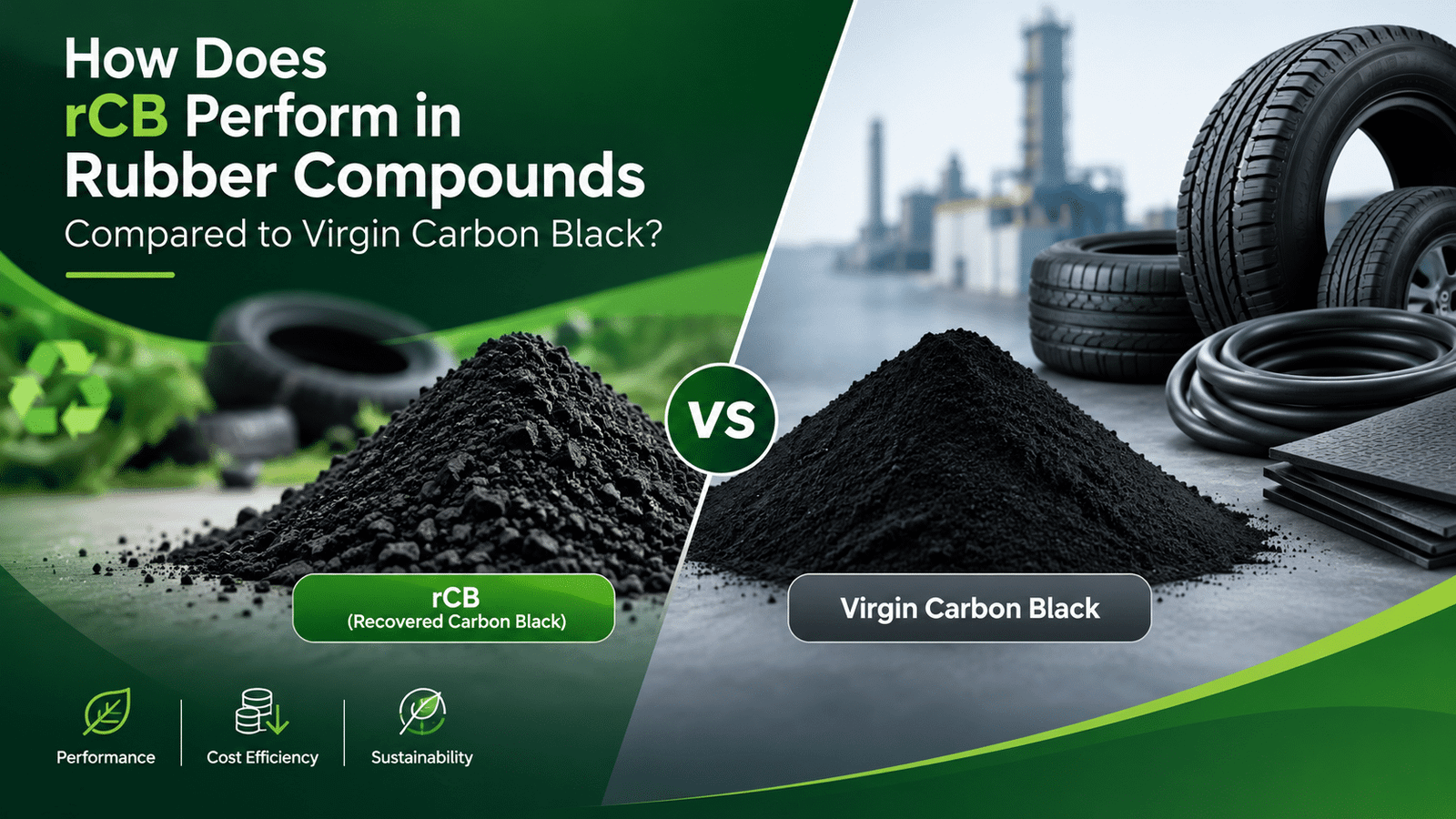
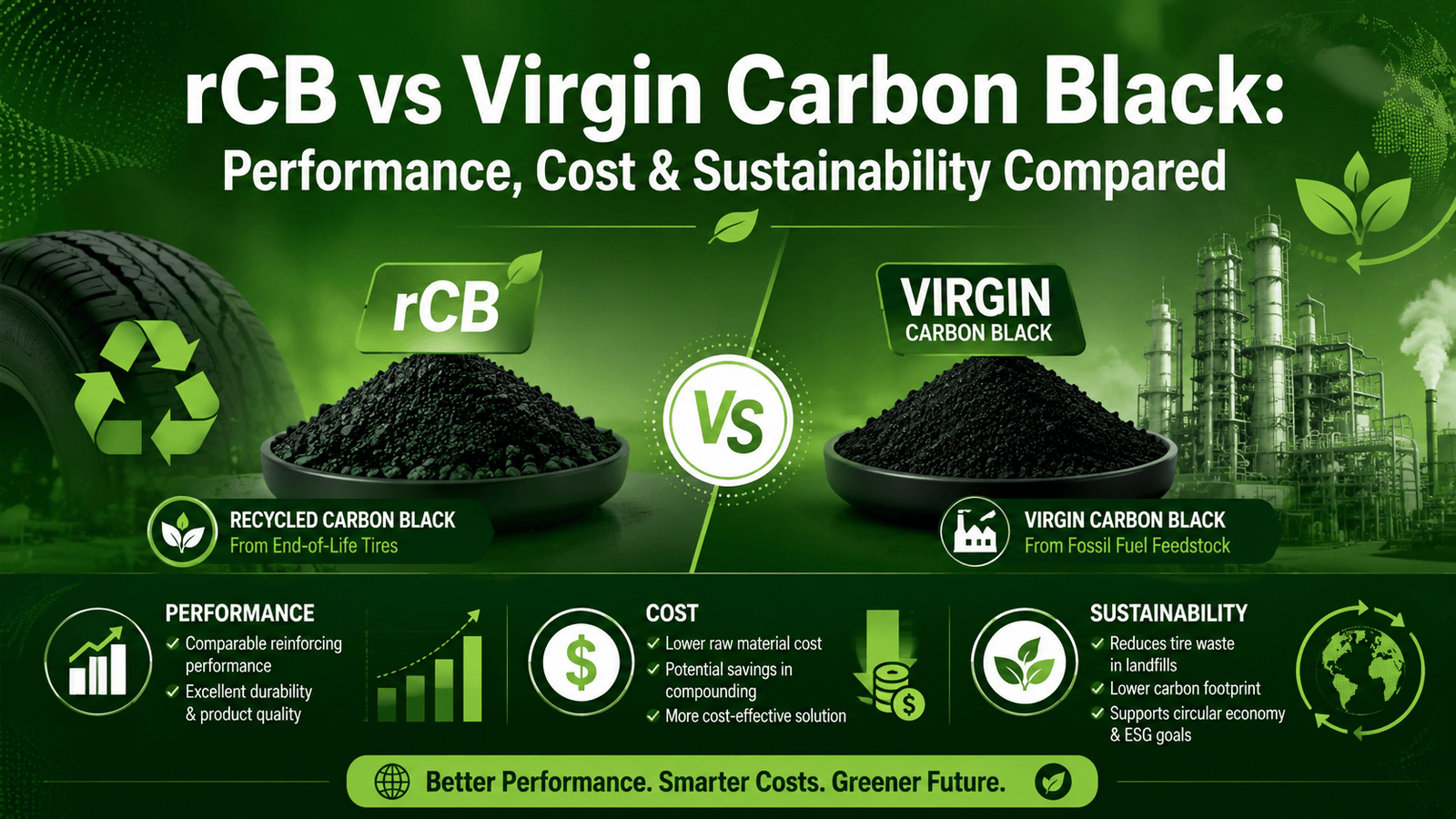
Recovered carbon black (rCB) is produced from end-of-life tyre pyrolysis, while virgin carbon black (vCB) is manufactured from fossil-fuel feedstocks. As a compounding filler substitute, rCB delivers comparable performance to semi-reinforcing vCB grades (N550–N772) at 30–50% lower cost and roughly 80% lower carbon emissions. Virgin carbon black still leads in high-reinforcing tread applications. For most non-tread, industrial rubber, and polymer applications, rCB is now the more economical and sustainable formulation substitute.
What Is Recovered Carbon Black (rCB)?
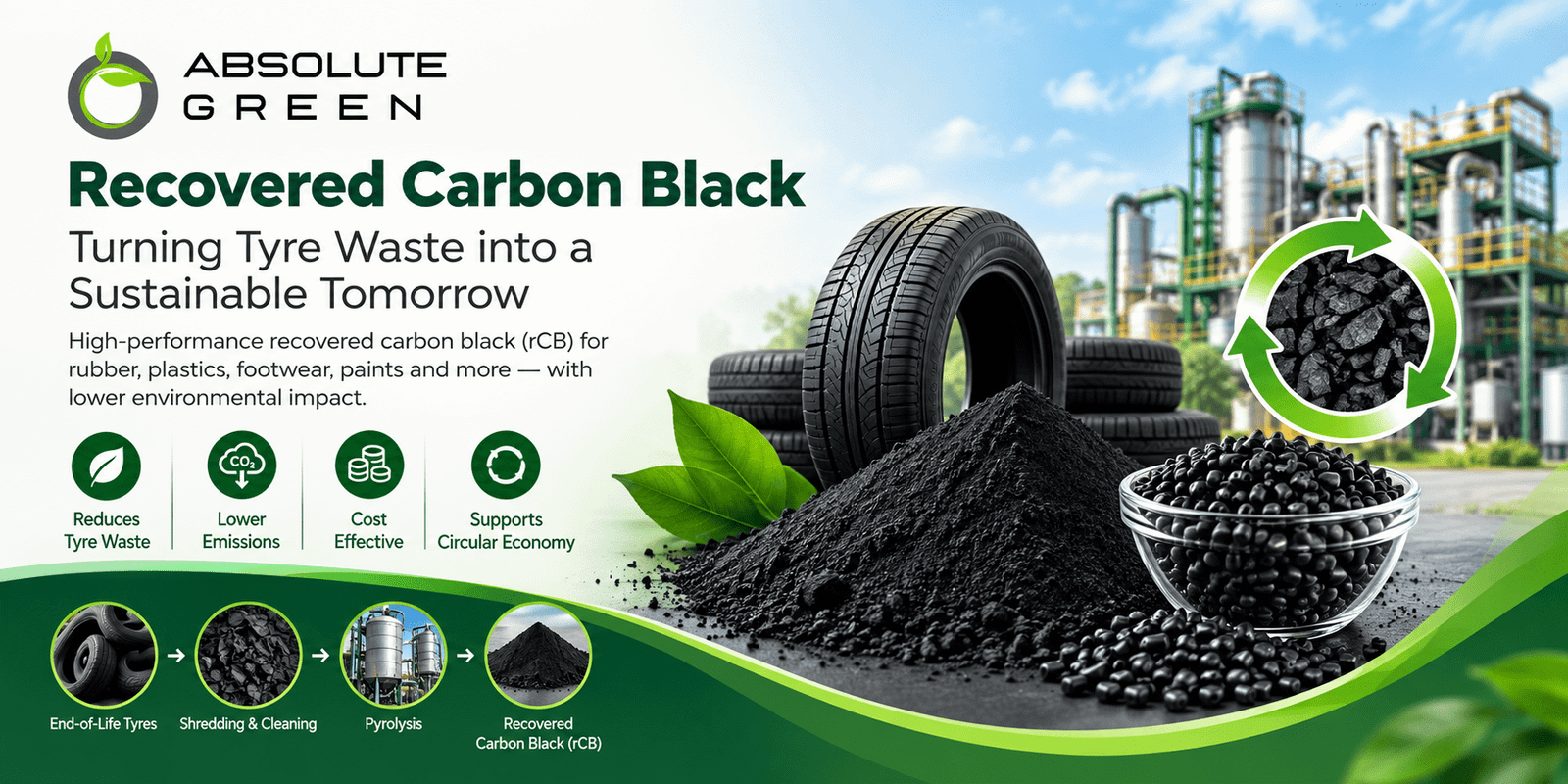
Recovered carbon black is a sustainable, carbonaceous filler material produced through the controlled pyrolysis of end-of-life tyres (ELTs) and rubber waste. During pyrolysis, shredded tyre rubber is heated to 400–600°C in an oxygen-free reactor, breaking the rubber into pyrolysis oil, gas, and a solid carbon char. The char is then milled, demineralized, and pelletized to produce a finished industrial filler.
Modern rCB grades, particularly those produced under controlled industrial processes, exhibit properties closely comparable to semi-reinforcing virgin carbon black grades such as N550, N660, and N772. rCB is now formally recognized under ASTM D8178, which provides terminology and classification guidance for the material as a filler substitute in commercial markets.
What Is Virgin Carbon Black?
Virgin carbon black is a high-purity, engineered carbonaceous filler manufactured through the partial combustion or thermal decomposition of fossil-fuel feedstocks, primarily heavy aromatic petroleum oil and, to a lesser extent, coal tar. The dominant production route is the furnace black process, which accounts for the majority of global vCB output. Other processes include thermal black, channel black, and acetylene black, each producing materials with distinct properties.
Virgin carbon black has been the workhorse reinforcing filler of the rubber industry since the early 20th century. Grades are standardized under ASTM D1765, with classifications such as N110, N220, N330, N550, N660, and N772 reflecting different surface area, structure, and reinforcement characteristics. vCB delivers very high carbon purity (typically 95–99%) and consistent, well-documented performance, particularly in tread compounds requiring maximum abrasion resistance.
Manufacturing Process: How rCB and Virgin Carbon Black Are Made
The fundamental difference between the two materials begins at the feedstock.
Virgin Carbon Black Production
- Feedstock: Heavy petroleum oil or coal tar.
- Process: High-temperature partial combustion (1,200–1,900°C) in a furnace reactor.
- Output: Highly engineered carbon black with tightly controlled particle size, surface area, and structure.
- Byproducts: Significant CO₂ emissions, tail gases, and process water.
- Energy intensity: Very high.
Recovered Carbon Black Production
- Feedstock: End-of-life tyres and rubber waste.
- Process: Oxygen-free pyrolysis at 400–600°C.
- Output: Carbon char, pyrolysis oil, and pyrolysis gas (often used to fuel the reactor).
- Byproducts: Significantly lower direct CO₂ emissions; tyres are diverted from landfill.
- Energy intensity: Moderate, with potential for self-sustaining energy loops.
This contrast is not just operational; it defines the entire sustainability story of rCB. Virgin carbon black extracts new carbon from fossil reserves, while rCB recovers carbon that was already manufactured once, serving as a functional filler material to close the loop.
Performance Comparison: rCB vs Virgin Carbon Black
Performance is where most procurement debates begin and where most material decisions are ultimately made.
Reinforcement and Mechanical Properties
Virgin carbon black, particularly tread-grade vCB (N100 and N200 series), delivers the highest reinforcement levels available in the market. These grades are engineered for the abrasion-intensive demands of passenger and truck tyre treads, where service life and rolling resistance are decisive.
Recovered carbon black, by contrast, performs in the semi-reinforcing range, closely tracking the properties of N550, N660, and N772 vCB grades. In semi-reinforcing applications, rCB-containing compounds typically achieve tensile strength within 85–95% of vCB equivalents, comparable elongation at break, and similar abrasion resistance.
Detailed Technical Properties Comparison
| Technical Property | Recovered Carbon Black (rCB) | Virgin Carbon Black (vCB) |
| Carbon content | 80–90% | 95–99% |
| Ash content | 8–18% | Less than 1% |
| Iodine adsorption number | 40–80 mg/g | 20–160+ mg/g (grade-dependent) |
| Oil absorption number (OAN) | 70–130 ml/100g | 60–140 ml/100g |
| Surface area | 30–90 m²/g | 7–150+ m²/g |
| Volatile matter | Less than 2% | Less than 2% |
| Moisture content | Less than 1% | Less than 1% |
| Reinforcement equivalence | N550, N660, N772 | Full N100–N900 series |
| Batch consistency | Improving, supplier-dependent | Highly standardized |
For non-tread tyre components, industrial rubber goods, conveyor belts, hoses, automotive rubber parts, and polymer compounds, rCB performs at industrially acceptable levels as a compounding substitute. For tread compounds and other high-reinforcing applications, virgin carbon black remains the technical benchmark.
Cost Comparison: Where rCB Wins on Economics
Cost is the most immediate and quantifiable advantage of rCB.
Pricing Dynamics
Virgin carbon black pricing is directly tied to crude oil and feedstock markets, which makes it highly volatile. Geopolitical events, OPEC decisions, and refinery economics all influence vCB pricing month to month.
Recovered carbon black is largely decoupled from crude oil pricing. Its primary cost drivers are tyre collection logistics, pyrolysis energy costs, and post-processing operations, all of which are more stable.
Cost Comparison Table
| Cost Factor | Recovered Carbon Black (rCB) | Virgin Carbon Black (vCB) |
| Unit price (relative) | 30–50% lower | Market benchmark |
| Price volatility | Low to moderate | High (oil-linked) |
| Logistics (domestic India) | Lower for regional supply | Often import-dependent |
| Long-term price predictability | Stable | Unpredictable |
| Compound cost impact | Material margin improvement at scale | Higher input cost burden |
For rubber and polymer manufacturers, even a partial substitution of vCB with rCB (10–30% in many compounds) delivers meaningful cost savings. At scale, across millions of kilograms of compound annually, these savings translate into measurable margin improvements. Beyond unit price, rCB offers a strategic insulation against oil price shocks, which is increasingly valued by procurement teams managing input cost volatility.
Sustainability Comparison: The Decisive Difference
Sustainability is where rCB does not just compete with virgin carbon black; it fundamentally outperforms it.
Carbon Footprint Analysis
Virgin carbon black production emits approximately 2.5 to 3.0 tonnes of CO₂ per tonne of carbon black produced, depending on the process and energy source. Recovered carbon black typically emits 0.4 to 0.6 tonnes of CO₂ per tonne produced, an approximate 80% reduction.
In addition to lower direct emissions, every tonne of rCB diverts roughly 2.5 to 3 tonnes of waste tyres from landfills, open burning, or incineration, addressing one of the world’s most pressing solid waste challenges.
Sustainability Comparison Table
| Sustainability Factor | Recovered Carbon Black (rCB) | Virgin Carbon Black (vCB) |
| Feedstock | Waste tyres (circular) | Fossil oil/coal tar (linear) |
| CO₂ emissions per tonne | 0.4–0.6 tonnes | 2.5–3.0 tonnes |
| Waste diverted from landfill | 2.5–3 tonnes per tonne rCB | None |
| Circular economy contribution | High | Low |
| Alignment with EPR mandates | Strong | None |
| Scope 3 emissions reduction | Significant | Not applicable |
| CBAM exposure (EU exports) | Lower | Higher |
For tyre and rubber manufacturers navigating India’s Extended Producer Responsibility (EPR) regulations for waste tyres, the EU’s Carbon Border Adjustment Mechanism (CBAM), and OEM Scope 3 emission disclosure requirements, rCB delivers verifiable compliance and reporting benefits that virgin carbon black structurally cannot.
Industrial Applications: Where Each Material Fits
The two materials are not always direct competitors. They often serve different application segments, and the most sophisticated compounders deploy both strategically.
Application Suitability Comparison
| Application Segment | Recovered Carbon Black (rCB) | Virgin Carbon Black (vCB) |
| Passenger tyre tread | Limited (small partial substitution) | Primary choice |
| Truck and bus tyre sidewalls | Strong fit | Used but cost-heavy |
| Tyre inner liners, bead fillers, carcass plies | Strong fit | Used |
| Off-the-road (OTR) tyre non-tread sections | Strong fit | Used |
| Conveyor belts (cover compounds) | Strong fit | Used |
| Hoses, tubes, automotive rubber parts | Strong fit | Used |
| Engine mounts, bushings, weather seals | Strong fit | Used |
| Footwear soles | Excellent fit | Used |
| Plastic and polymer masterbatches | Strong fit | Used |
| PVC and HDPE pipe compounds | Strong fit | Used |
| High-performance specialty rubbers | Limited | Primary choice |
| Inks, coatings, pigments | Suitable (after refinement) | Primary choice |
| Asphalt and bitumen modification | Suitable | Used |
Rubber and Tyre Industry Use Cases
The tyre industry is the largest consumer of carbon black globally, and it is also the most active testbed for rCB adoption. Major global tyre manufacturers have publicly committed to incorporating significant percentages of recovered or sustainable materials in their products by 2030.
In current commercial practice, rCB is used predominantly as a formulation filler substitute in non-tread tyre components, including sidewalls, inner liners, bead fillers, and carcass plies. For these applications, the performance match with semi-reinforcing virgin carbon black grades is well documented, and the cost and sustainability benefits are decisive.
For tread compounds, where N100 and N200 series virgin carbon blacks deliver maximum abrasion resistance and rolling resistance optimization, rCB is currently used in limited partial substitution. Ongoing R&D in surface modification and post-processing is gradually expanding rCB’s reach into more demanding applications.
Pros and Cons of rCB and Virgin Carbon Black
Recovered Carbon Black: Strengths
- Significant cost advantage (30–50% lower than vCB)
- Approximately 80% lower carbon footprint
- Decoupled from crude oil price volatility
- Diverts waste tyres from landfill and incineration
- Aligns with EPR, CBAM, and ESG frameworks
- Domestic Indian supply reduces import dependence
- Performance fully adequate for most semi-reinforcing filler applications
Recovered Carbon Black: Limitations
- Higher ash content than vCB
- Not yet a full substitute for high-reinforcing tread-grade vCB
- Batch-to-batch consistency requires supplier diligence
- May require minor adjustments in mixing protocols
- Industry standardization still maturing (though improving with ASTM D8178)
Virgin Carbon Black: Strengths
- Highest reinforcement levels available, particularly for tread compounds
- Extremely consistent quality and standardization
- Full spectrum of grades (N100–N900) for any application
- Decades of formulation data and industry familiarity
- Optimal for specialty and high-performance applications
Virgin Carbon Black: Limitations
- High carbon footprint and fossil-fuel dependence
- Price volatility tied to crude oil markets
- Exposure to carbon pricing regulations (CBAM, future carbon taxes)
- No circular economy contribution
- Higher absolute cost burden on compound formulations
- Often import-dependent for Indian buyers, adding logistics costs
When to Choose rCB vs Virgin Carbon Black
The decision is rarely binary. Most leading compounders today use both materials strategically, optimizing for performance, cost, and sustainability across their product range.
Choose rCB when:
- Your application falls in the semi-reinforcing filler range (N550, N660, N772 equivalents)
- Cost reduction is a strategic priority
- Your organization has carbon footprint, ESG, or Scope 3 disclosure obligations
- Your products are exported to markets with carbon pricing (EU CBAM)
- You operate in non-tread tyre components, industrial rubber, or polymer compounding
- Your customers (OEMs, brand owners) require sustainable material content
- You want to reduce exposure to crude oil price volatility
Choose Virgin Carbon Black when:
- Your application is in passenger tyre treads or high-performance specialty rubber
- Maximum reinforcement is non-negotiable
- Regulatory or technical specifications mandate specific vCB grades
- You require established, decades-long formulation databases
A practical middle path:
For most compounders, the most effective approach is partial formulation substitution. Replacing 10–30% of semi-reinforcing vCB content with rCB, or formulating new compounds with rCB as the primary filler material in non-tread applications, captures the cost and sustainability benefits while preserving performance in critical components.
Future Market Trends
The trajectory of the rCB and virgin carbon black markets is being reshaped by several converging forces.
- OEM commitments: Global tyre manufacturers including Bridgestone, Michelin, Continental, and Goodyear have publicly committed to sustainable material targets for 2030 and beyond, structurally increasing demand for rCB as a filler substitute.
- Regulatory pressure: India’s EPR rules for waste tyres, the EU CBAM, and similar policies globally are creating both supply-side and demand-side momentum for sustainable filler choices.
- Capacity expansion: Global rCB production capacity is expanding rapidly across India, Europe, North America, and Southeast Asia, improving availability and supply security.
- Standardization maturity: ASTM D8178 and emerging international standards are increasing buyer confidence and easing technical specification.
- Technology advancement: Surface modification, demineralization, and advanced post-processing technologies are progressively closing the performance gap between rCB and higher-reinforcing vCB grades.
- Carbon pricing economics: As carbon costs are increasingly internalized into material pricing, virgin carbon black’s structural cost will rise relative to rCB.
- India’s strategic positioning: With one of the world’s largest waste tyre generation bases and a rapidly growing manufacturing sector, India is emerging as a critical rCB production and consumption hub.
Frequently Asked Questions
The main difference is the feedstock and production process. Virgin carbon black is manufactured from petroleum oil or coal tar through high-temperature furnace combustion. Recovered carbon black is produced from end-of-life tyres through pyrolysis. rCB has a much lower carbon footprint, lower cost, and functions as a sustainable filler substitute best suited to semi-reinforcing applications.
For semi-reinforcing filler applications (equivalent to N550, N660, N772 grades), rCB delivers comparable strength and reinforcement. In compounds, properly produced rCB typically achieves 85–95% of the tensile strength of equivalent vCB. For high-reinforcing tread applications, virgin carbon black still leads.
Recovered carbon black is typically 30–50% less expensive than equivalent virgin carbon black grades. The exact differential depends on rCB grade, virgin carbon black market conditions (which track crude oil prices), region, and order volumes.
Yes, significantly. Recovered carbon black has approximately 80% lower carbon emissions than virgin carbon black. It also diverts 2.5–3 tonnes of waste tyres from landfill per tonne of rCB produced, making it a verified circular economy filler material.
rCB can replace virgin carbon black as a formulation substitute in non-tread tyre components such as sidewalls, inner liners, bead fillers, and carcass plies. For tread compounds, it is currently used in limited partial substitution only.
Tyre pyrolysis carbon black is another term for recovered carbon black produced specifically from end-of-life tyres through the pyrolysis process. It is processed to serve as a sustainable filler substitute for commercial compounding.
ASTM D8178 is the primary international standard providing terminology and classification guidance for recovered carbon black, helping standardize specifications and trade in commercial markets.
Manufacturers are switching to rCB for three converging reasons: significant cost savings, lower carbon footprint, and compliance with sustainability mandates including EPR regulations, CBAM, and OEM decarbonization targets. Its utility as a filler substitute has lowered adoption barriers.
Yes. rCB typically has 8–18% ash content compared to less than 1% for virgin carbon black. This is because rCB is derived from tyre rubber that contains zinc oxide, silica, and other compounding ingredients. Demineralization and advanced post-processing technologies are progressively reducing this gap.
Absolute Green Carbon, based in Hapur, Uttar Pradesh, manufactures and supplies recovered carbon black to rubber, tyre, and polymer manufacturers across India and international markets. The company offers technical data sheets, sample programs, and capacity-backed commercial agreements.
Make the Switch to Sustainable Filler Solutions with Absolute Green Carbon
The rCB vs virgin carbon black decision is no longer theoretical. It is a real, quantifiable choice affecting raw material costs, carbon disclosures, OEM relationships, and long-term supply security. For most semi-reinforcing applications across the rubber, tyre, and polymer industries, recovered carbon black now delivers the strongest combination of performance, economics, and sustainability.
Absolute Green Carbon, a division of Absolute Green Polymers Pvt Ltd, operates from Hapur, India, manufacturing consistent, performance-grade recovered carbon black for rubber compounders, tyre manufacturers, polymer processors, and industrial product makers. Our technical team supports buyers with product data sheets, sample evaluations, application-specific guidance, and capacity-backed commercial agreements.
To request a technical specification sheet, a sample for evaluation, or a commercial quotation, connect directly with our engineering and procurement desks.