For rubber compounders, tyre manufacturers, and polymer producers across India, raw material cost is one of the most closely watched line items on every quarterly P&L. Within that line, carbon black represents one of the largest individual inputs. As recovered carbon black (rCB) becomes an increasingly mainstream filler substitute to blend alongside virgin carbon black, procurement teams are asking a direct, practical question: what does recovered carbon black actually cost per tonne in India, and what factors drive that price up or down?
Unlike commodity petrochemicals with daily published index prices, rCB pricing varies meaningfully across suppliers, grades, regions, and order volumes. Understanding the underlying cost drivers is essential for procurement teams negotiating contracts, evaluating supplier quotations, or building accurate compound cost models.
As a Hapur-based manufacturer of recovered carbon black, Absolute Green Carbon (a division of Absolute Green Polymers Pvt Ltd) works directly with industrial buyers evaluating rCB pricing across India and export markets. This guide breaks down the real cost structure of recovered carbon black in India, the factors that shape per-tonne pricing, and how buyers can evaluate quotations intelligently.
Quick Answer: What Is the Recovered Carbon Black Price in India?
The recovered carbon black price in India typically ranges between ₹35,000 and ₹65,000 per tonne, depending on grade, ash content, particle size, packaging, and order volume. This is approximately 30–50% lower than virgin carbon black pricing. Key factors influencing cost include feedstock quality, pyrolysis process technology, post-processing (milling, demineralization, pelletization), logistics, and supplier capacity. Bulk industrial orders attract preferential pricing.
Indicative pricing only. Actual quotations vary by specification, volume, and market conditions. Contact suppliers directly for current rates.
What Is Recovered Carbon Black (rCB)?
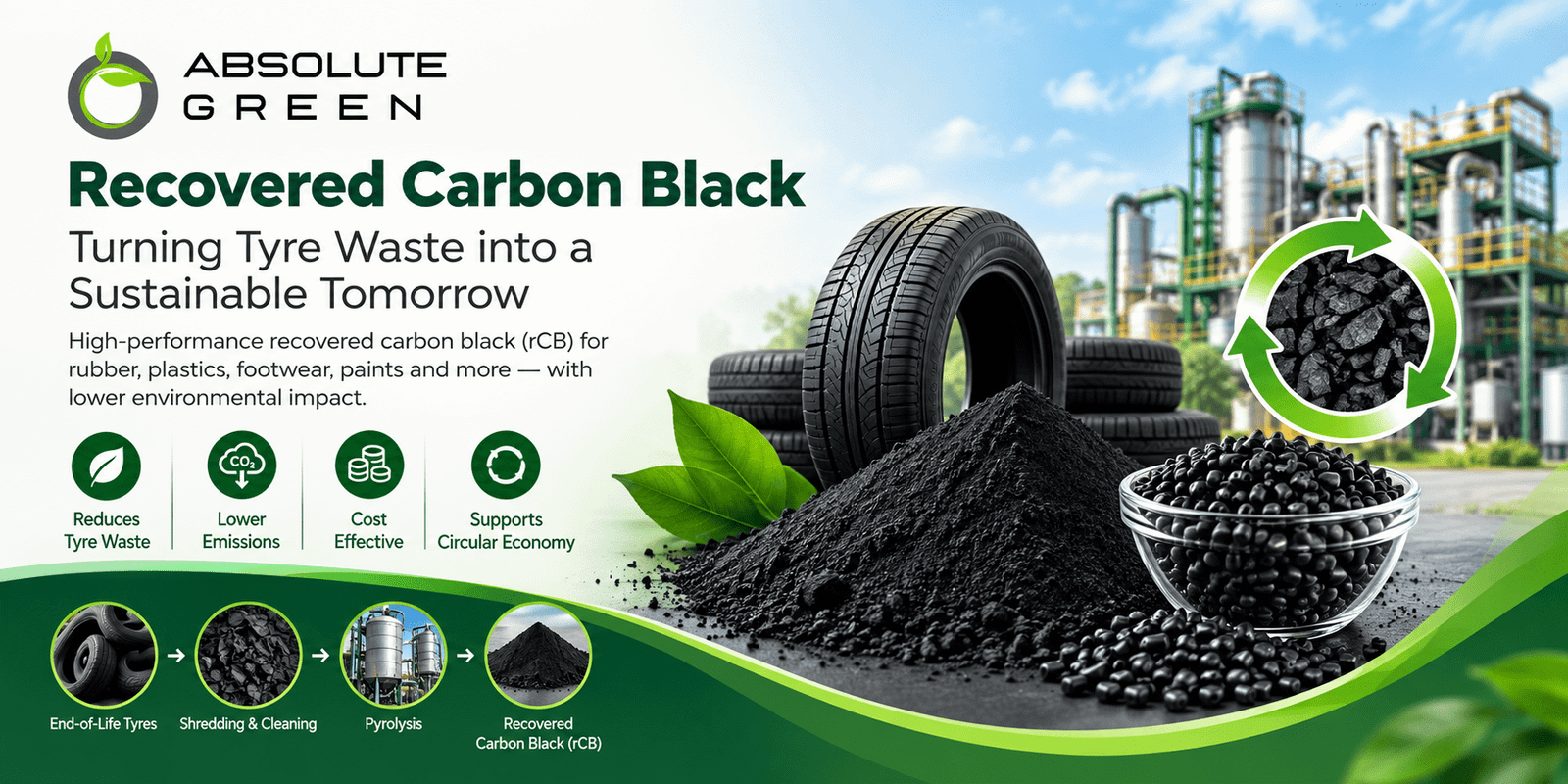
Recovered carbon black is a sustainable industrial filler produced from the pyrolysis of end-of-life tyres (ELTs) and rubber waste. Shredded tyre rubber is heated to 400–600°C in an oxygen-free reactor, decomposing the rubber into pyrolysis oil, gas, and a solid carbon char. The char is then milled, often demineralized, and typically pelletized into a finished industrial product.
The resulting material delivers performance comparable to semi-reinforcing virgin carbon black grades such as N550, N660, and N772, at significantly lower cost and roughly 80% lower carbon emissions. rCB is now formally recognized under ASTM D8178, the international standard for terminology and classification of recovered carbon black.
For Indian buyers, rCB is increasingly used as a compounding substitute in non-tread tyre components, conveyor belts, industrial rubber goods, polymer masterbatches, footwear, and coatings, where it delivers strong performance at a meaningfully lower per-tonne cost than virgin carbon black.
Average Recovered Carbon Black Price in India
Pricing varies based on multiple commercial and technical factors, but indicative ranges in the Indian market typically fall within the following bands:
| rCB Grade Category | Typical Price Range (₹ per tonne) | Best-Suited Applications |
| Standard powder grade | ₹35,000 – ₹45,000 | Industrial rubber, masterbatches, non-critical applications |
| Pelletized standard grade | ₹40,000 – ₹50,000 | Conveyor belts, hoses, automotive rubber, polymer compounds |
| Premium pelletized grade | ₹50,000 – ₹60,000 | Non-tread tyre components, performance rubber, demanding compounds |
| Demineralized / specialty grade | ₹55,000 – ₹65,000+ | Premium applications, export markets, specialty compounds |
Pricing is indicative and reflects general market ranges. Actual quotations depend on specification, volume, location, and current market conditions.
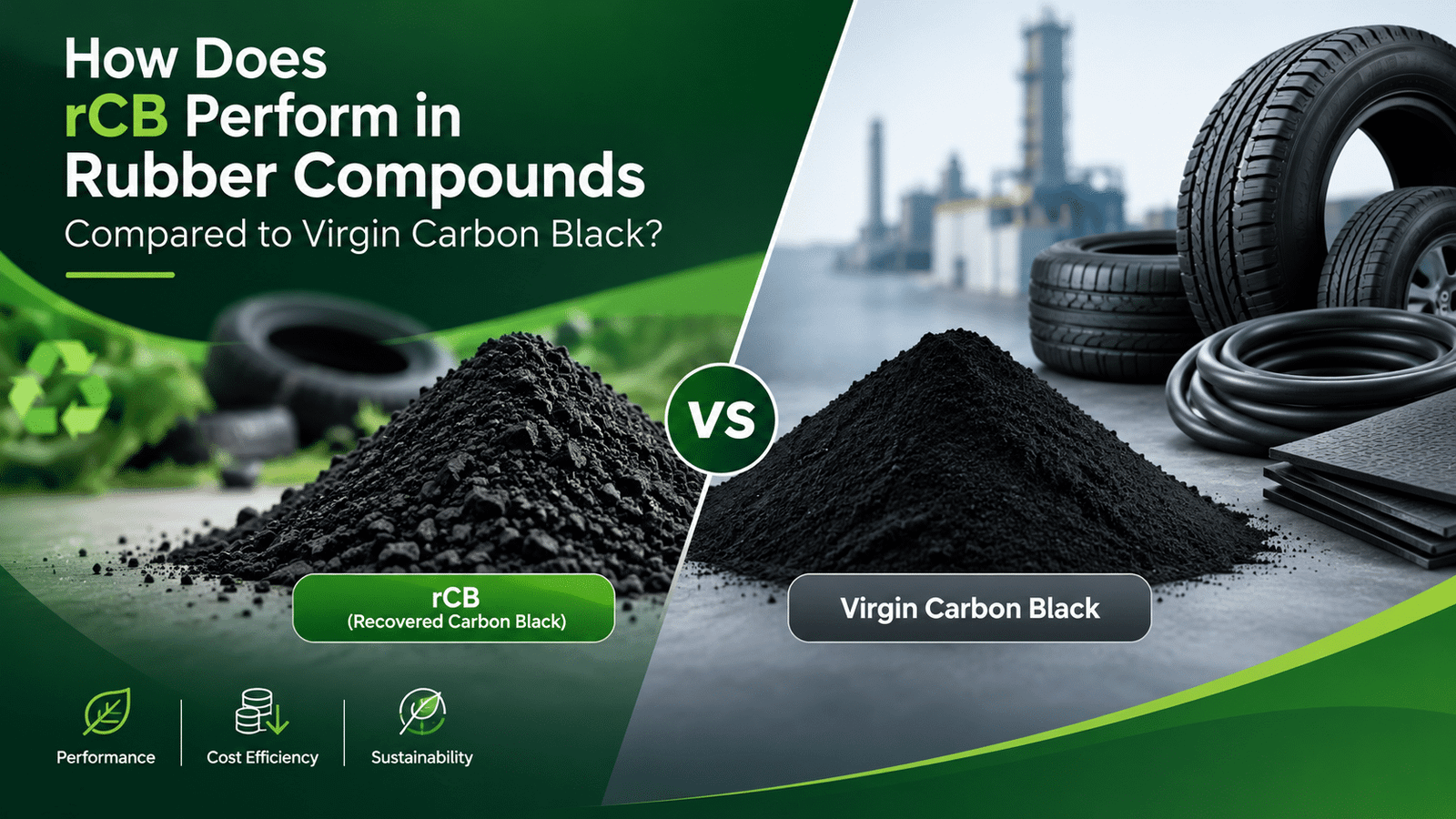
For comparison, virgin carbon black grades (N550–N772) in India typically range between ₹70,000 and ₹110,000 per tonne, depending on grade and global oil markets, making rCB a substantial cost-saving formulation substitute.
Factors Affecting rCB Price Per Tonne
No two rCB quotations are directly comparable without understanding the underlying drivers. The following factors collectively determine per-tonne pricing.
1. Quality Grade and Specifications
Higher-performance grades command higher prices. Key specification parameters affecting pricing include:
- Carbon content (higher carbon = higher price)
- Ash content (lower ash = higher price)
- Iodine adsorption number (closer to vCB equivalence = higher price)
- Oil absorption number (OAN)
- Particle size and distribution
- Volatile matter and moisture content
- Batch-to-batch consistency
A standard powder rCB suitable for industrial rubber goods will be priced very differently from a demineralized, micronized, premium-grade product engineered to substitute portions of a mix for non-tread tyre compounds.
2. Feedstock Quality and Sourcing
The quality of the input tyres directly affects the quality of the output rCB.
- Passenger car tyres generally yield rCB with different properties than truck and bus tyres
- Clean, segregated tyre feedstock produces more consistent rCB
- Mixed or contaminated feedstock can introduce variability and higher ash content
- Feedstock collection logistics influence per-tonne input cost
Manufacturers with reliable, contracted feedstock supply chains generally deliver more consistent pricing and quality than those relying on spot-market scrap.
3. Manufacturing and Processing Costs
Production economics vary significantly between rCB manufacturers.
- Pyrolysis reactor technology: Batch vs continuous; modern continuous reactors have better unit economics.
- Energy efficiency: Pyrolysis gas reuse, heat recovery.
- Post-processing capability: Milling, sieving, demineralization, pelletization.
- Quality control infrastructure: In-house testing labs, batch tracking.
- Plant scale and utilization.
A manufacturer running a modern continuous pyrolysis plant with integrated post-processing typically delivers more competitive and consistent pricing than smaller batch operations.
4. Physical Form and Packaging
The physical form of rCB affects both pricing and handling cost.
- Powder form is generally less expensive but harder to handle and may incur dust losses.
- Pelletized form (wet or dry pelletization) is preferred by industrial users and priced higher due to cleaner mixing lines.
- Micronized grades for specialty applications carry premium pricing.
- Packaging options include 25 kg bags, 500–1000 kg jumbo bags, and bulk containers; bulk packaging generally offers better per-tonne economics.
5. Order Volume
Bulk industrial orders typically attract preferential pricing.
- Spot or trial orders (under 5 tonnes) usually carry full list pricing.
- Standing orders (50–500 tonnes per month) benefit from volume discounts.
- Annual contracts with committed offtake unlock the most favorable pricing and supply security.
6. Supply Chain and Transportation
Logistics costs are a meaningful component of delivered price, particularly across India’s geographically dispersed manufacturing clusters.
- Domestic regional supply (e.g., Hapur to Delhi-NCR, Punjab, Haryana, Western UP) involves lower logistics cost.
- Cross-country freight to South or East India adds to landed cost.
- Packaging and handling affect freight efficiency.
- Mode of transport (road vs rail) varies by volume and destination.
Sourcing from a regionally located manufacturer can reduce delivered cost meaningfully, particularly for buyers in North and Central India.
7. Market Dynamics
Like all industrial commodities, rCB pricing responds to broader market forces:
- Virgin carbon black price movements (driven by crude oil markets)
- Tyre feedstock availability and pricing
- Energy and fuel costs affecting pyrolysis operations
- Capacity utilization across the Indian rCB industry
- Export demand pulling supply toward international markets
- Regulatory developments including EPR implementation and CBAM
Domestic vs Imported Carbon Black Sourcing in India
Indian buyers often evaluate domestic rCB filler options against imported virgin or recovered carbon black from China, Southeast Asia, or other markets.
| Pricing Factor | Domestic rCB (India) | Imported Carbon Black |
| Base price | Competitive, stable | Variable, FX-dependent |
| Freight and logistics | Lower for regional supply | Significant ocean and inland freight |
| Customs duty & clearance | Not applicable | Adds to landed cost |
| Foreign exchange exposure | None | Rupee-dollar volatility |
| Lead times | Shorter, more predictable | Longer, vulnerable to shipping disruptions |
| Supply security | High | Lower (geopolitical, logistics risks) |
| Sustainability narrative | Strong (domestic circular economy) | Weaker |
| EPR alignment | Direct | Indirect |
For most Indian rubber and polymer manufacturers, domestic rCB sourcing offers better landed cost economics, faster lead times, stronger supply security, and clearer alignment with sustainability and EPR objectives.
rCB vs Virgin Carbon Black: Cost Comparison
The headline economic case for rCB is its cost advantage when used as a formulation substitute alongside virgin carbon black.
| Cost Parameter | Recovered Carbon Black (rCB) | Virgin Carbon Black (vCB) |
| Typical price per tonne (India) | ₹35,000 – ₹65,000 | ₹70,000 – ₹1,10,000+ |
| Price volatility | Low to moderate | High (oil-linked) |
| Crude oil exposure | Minimal | Direct |
| FX exposure (for imports) | Lower (domestic supply) | High |
| Carbon cost exposure (CBAM) | Lower | Higher |
| Long-term price predictability | Stable | Unpredictable |
Indicative pricing only. Virgin carbon black pricing tracks global oil markets and varies by grade and supplier.
For a rubber compounder consuming several thousand tonnes of carbon black annually, a partial formulation substitution of vCB with rCB (10–30% blend replacement, which is technically feasible in many compounds) delivers substantial raw material cost savings.
Bulk Order Pricing Considerations
For industrial procurement teams, the most favorable pricing is unlocked through volume commitments and structured commercial agreements.
Pricing Tiers Typically Offered
- Trial / sample orders (under 1 tonne): Full list pricing, intended for technical evaluation.
- Small orders (1–10 tonnes): Standard pricing with minimal discounts.
- Medium volume orders (10–100 tonnes): Volume discounts begin.
- Bulk orders (100–500+ tonnes per month): Preferential pricing, flexible payment terms.
- Annual offtake contracts: Best pricing, dedicated supply allocation, fixed or indexed pricing structures.
Commercial Terms That Affect Effective Price
- Payment terms (advance, credit, LC)
- Delivery terms (ex-works, FOR destination, CIF for exports)
- Packaging specifications
- Quality testing and acceptance protocols
- Force majeure and supply guarantee clauses
- Price escalation or indexation mechanisms
A well-structured annual contract with a reliable Indian rCB manufacturer typically delivers 10–20% better effective pricing than spot purchasing, along with supply security and quality consistency.
How Buyers Evaluate Cost vs Performance
Sophisticated procurement teams evaluate rCB on landed cost-per-performance, not just sticker price per tonne.
Key Evaluation Metrics
- Compound cost per kilogram (not just filler cost per tonne)
- Reinforcement equivalence (the specific extent to which this rCB can substitute the vCB grade)
- Substitution ratio (how much rCB blends cleanly into the compound formula)
- Processing cost impact (any changes to mixing time, energy, scrap rates)
- End-product performance (does the finished part meet specification)
- Quality consistency (batch-to-batch variability)
- Carbon footprint contribution (Scope 3 reduction value)
- Regulatory benefit (EPR credits, CBAM exposure reduction)
A slightly higher-priced premium-grade rCB that delivers tighter quality consistency, better dispersion, and lower compound rework rates often produces a lower true cost-per-performance than a cheaper but less consistent alternative.
Future Pricing Trends for rCB in India
Several structural forces will shape rCB pricing in India over the coming years.
Upward pressure on rCB pricing:
- Growing demand from tyre manufacturers committing to sustainable material targets
- Export demand from European and Southeast Asian markets
- Quality premium as buyers shift toward higher-grade rCB
- Carbon pricing benefits making rCB economically more attractive (and supporting higher margins for producers)
Downward / stabilizing pressure on rCB pricing:
- Capacity expansion across India improving supply availability
- Process technology improvements lowering production cost per tonne
- Standardization (ASTM D8178 and emerging Indian standards) reducing quality variability and trading friction
- Feedstock supply scaling up under formal EPR frameworks
Net Outlook
Continued strong rCB cost advantage when used as a formulation substitute over virgin carbon black, alongside gradual premium pricing for high-grade, demineralized, and specialty rCB. For procurement teams, the strategic implication is clear: building long-term supplier relationships with reliable, capacity-backed Indian rCB manufacturers now will lock in both cost and supply advantages as the market scales.
Frequently Asked Questions
The recovered carbon black price in India typically ranges between ₹35,000 and ₹65,000 per tonne, depending on grade, form (powder or pellet), ash content, quality consistency, and order volume. Standard pelletized grades for general industrial use generally fall in the ₹40,000–₹50,000 range, while premium grades for non-tread tyre and demanding compound applications command higher pricing.
Recovered carbon black is typically 30–50% cheaper than virgin carbon black on a per-tonne basis. The exact savings depend on the specific compound formulation blend ratio, rCB grade, virgin carbon black market conditions, region, and order volume.
Key factors include rCB grade and specifications (carbon content, ash content, iodine number, OAN), feedstock quality, pyrolysis and post-processing technology, form (powder vs pelletized), packaging, order volume, logistics, and broader market dynamics including virgin carbon black pricing and energy costs.
Generally no, once landed cost is considered. Imported carbon black involves ocean freight, customs duty, inland logistics, FX exposure, and longer lead times, which typically erode any apparent base-price advantage. Sourcing domestic rCB as a formula substitute from Indian manufacturers like Absolute Green Carbon usually delivers better landed cost, supply security, and EPR alignment.
Yes, significantly. Bulk industrial orders, particularly under annual contracts of 100+ tonnes per month, typically attract preferential pricing 10–20% below spot rates. Volume commitments also unlock better payment terms, supply allocation, and quality consistency commitments.
Pelletized rCB typically commands a premium of ₹3,000–₹7,000 per tonne over powder rCB, reflecting the added processing cost and significantly better handling characteristics. Most industrial users prefer pelletized rCB because it integrates better with automated mixing lines and reduces dust losses.
Higher ash content typically means lower pricing, while demineralized rCB with lower ash content commands a premium. This is because lower ash improves dispersion and overall compound performance, allowing it to substitute vCB in more demanding applications.
The Indian rCB market is maturing rapidly. While demand is rising due to OEM sustainability commitments and export opportunities, capacity expansion is broadly keeping pace. Net pricing is expected to remain stable to moderately upward, with widening premiums for high-grade and specialty rCB. The cost advantage over virgin carbon black is expected to remain strong.
Absolute Green Carbon, based in Hapur, Uttar Pradesh, manufactures and supplies recovered carbon black to rubber, tyre, and polymer manufacturers across India and export markets. Buyers can request technical data sheets, samples, and commercial quotations directly from the company’s procurement team.
Indirectly. rCB is not directly tied to crude oil markets the way virgin carbon black is, which gives rCB more stable, predictable pricing. However, when crude oil prices rise sharply, virgin carbon black prices rise, which can pull up rCB pricing as buyers shift formulation demand toward the more economical filler substitute.
Request a Quotation from Absolute Green Carbon
Understanding rCB pricing in the abstract is useful. Getting a specific, application-matched quotation for your operation is what actually drives procurement decisions.
Absolute Green Carbon, a division of Absolute Green Polymers Pvt Ltd, manufactures recovered carbon black at its Hapur, Uttar Pradesh facility and supplies to rubber compounders, tyre manufacturers, polymer processors, and industrial product makers across India and international markets. Our technical and commercial teams provide:
- Application-specific grade recommendations
- Detailed product data sheets and technical specifications
- Sample programs for compound trials and qualification
- Transparent, volume-based commercial quotations
- Annual contract structures with supply security commitments
- Regional logistics advantages for North, Central, and Western India
To request a current quotation, technical specification sheet, or sample for evaluation, connect directly with the Absolute Green Carbon procurement team. Industrial buyers, OEMs, and distributors evaluating sustainable filler partnerships are welcome to initiate inquiries.