Carbon black is a fine, black powder made almost entirely of elemental carbon, produced by the controlled, incomplete combustion or thermal decomposition of hydrocarbon materials. It’s the reinforcing agent behind vehicle tyres, industrial rubber goods, plastics, paints, and inks — and the reason most of those products are black in the first place.
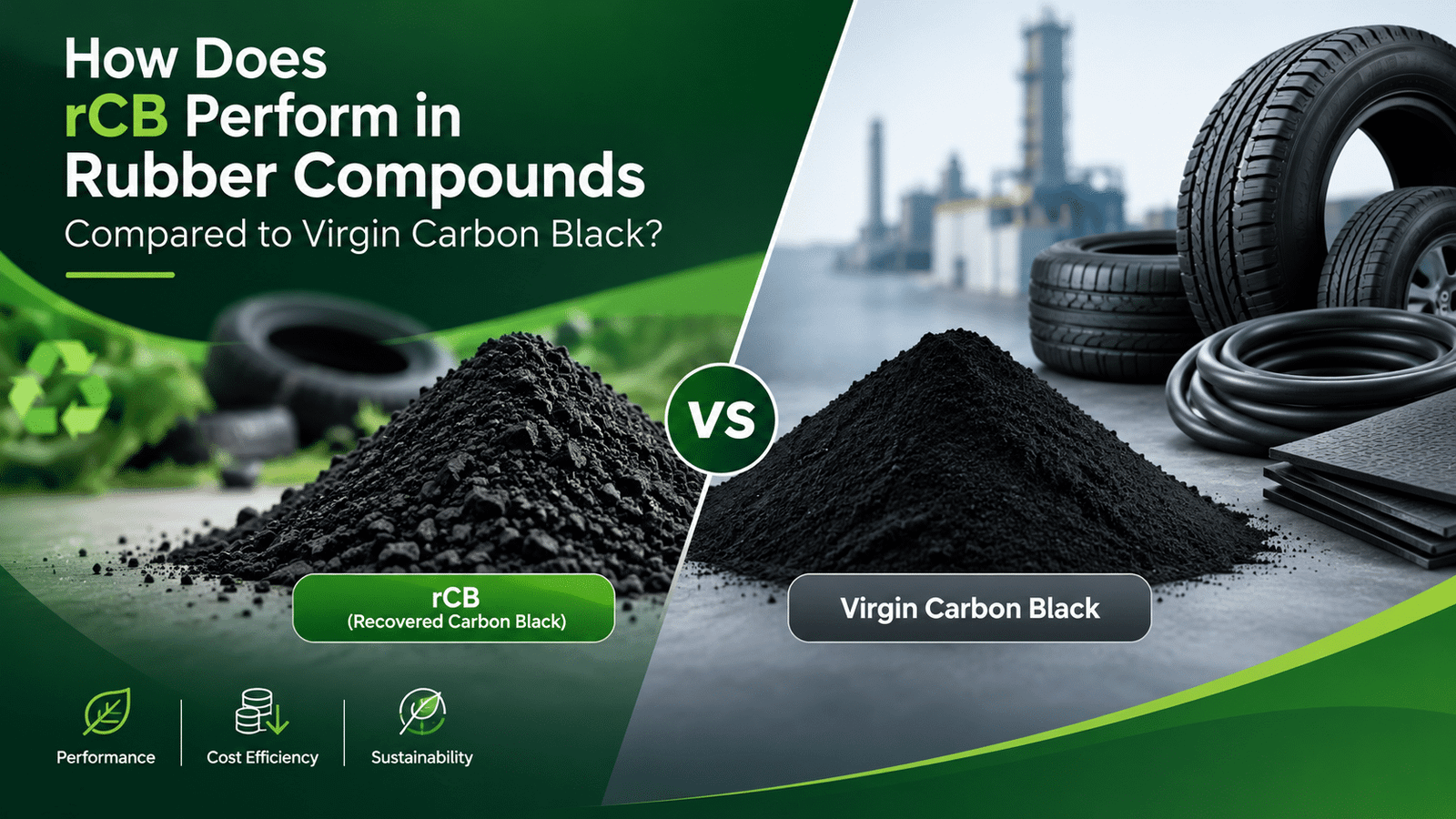
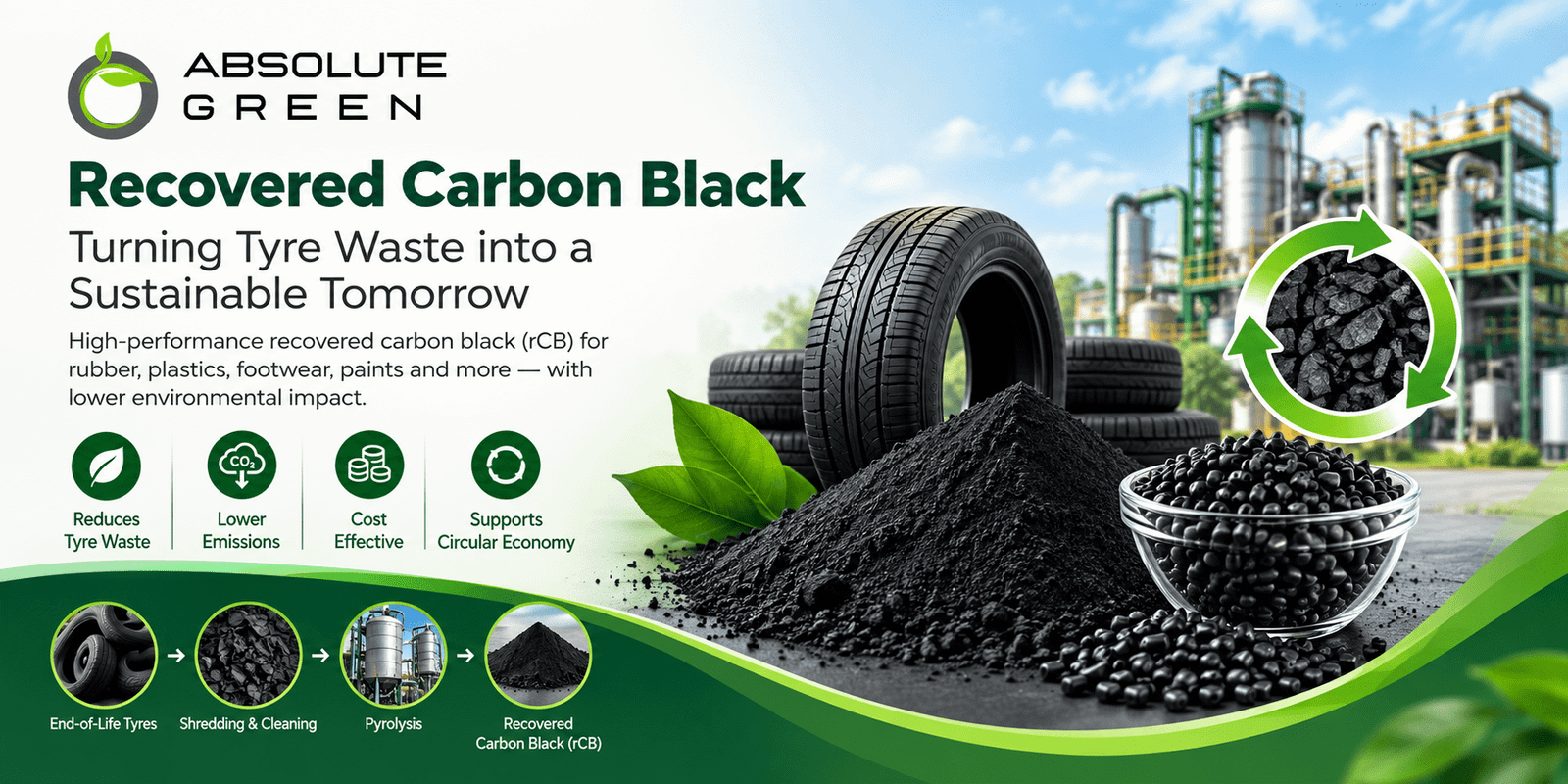
There are two very different ways to manufacture it. The traditional route, furnace black, burns petroleum-based oil at extremely high temperatures. A newer route, recovered carbon black (rCB), instead pyrolyzes end-of-life tyres, recovering carbon black at a lower cost and with a smaller carbon footprint. Both processes, and the grades they produce, are covered in detail below — including the underlying chemistry, step-by-step reactor stages, quality-control parameters, and how the two methods compare.
Table of Contents
- What Is Carbon Black Made Of?
- The Chemistry Behind Carbon Black Formation
- Carbon Black Manufacturing Process: 3 Main Methods
- Furnace Black vs Recovered Carbon Black (rCB)
- Carbon Black Grades Explained (N-Series)
- Quality Control & Testing Parameters
- Environmental Controls
- What Is Carbon Black Used For?
- FAQs
- Talk to a Carbon Black Manufacturer in India
What Is Carbon Black Made Of?
Carbon black is over 95% pure elemental carbon, structured as tiny, fused spherical particles called aggregates. Individual carbon particles (typically 10–300 nanometers in diameter) fuse together during formation into these aggregates, which then loosely cluster into larger agglomerates.
Three structural properties define how a given carbon black behaves in an end product:
- Particle size — smaller particles generally mean higher reinforcing strength and better UV protection, but lower processability.
- Structure — how branched or chain-like the aggregates are; higher-structure carbon black increases compound stiffness and electrical conductivity.
- Surface area — measured via nitrogen adsorption (BET/CTAB methods); higher surface area typically means stronger rubber-polymer bonding.
It should not be confused with soot or charcoal. All three are carbon-rich, but carbon black is manufactured under tightly controlled thermal and chemical conditions to produce a consistent, engineered material — unlike the uncontrolled combustion byproduct that is soot, or the biomass-derived origin of charcoal.
The Chemistry Behind Carbon Black Formation
Carbon black forms through pyrolysis and partial oxidation of hydrocarbon feedstock.
When a hydrocarbon — such as aromatic oil, or the rubber polymer in a shredded tyre — is exposed to very high heat with insufficient oxygen to fully combust it, the hydrogen atoms are stripped away faster than the carbon skeleton can react with oxygen.
What’s left behind is elemental carbon. This carbon nucleates into tiny particles, which collide and fuse into aggregates as they travel through the reaction zone.
The gas stream is then rapidly quenched (cooled) to stop further reaction and lock in the particle structure. The speed of this quenching step is one of the most critical control points in the entire process — it directly determines the final particle size and structure, which in turn determines what grade of carbon black comes out the other end.
Carbon Black Manufacturing Process: 3 Main Methods
1. Furnace Black Process (most common — ~95% of world production)
Feedstock: Aromatic oil (typically a byproduct of petroleum refining or coal tar distillation), chosen for high carbon content and low sulfur.
Process stages:
- Preheating — Feedstock oil is preheated to improve atomization when injected into the reactor.
- Combustion chamber — A portion of the feedstock (or natural gas) is fully combusted with air to generate a high-temperature gas stream, typically 1,300–1,800°C.
- Feedstock injection — The main oil feedstock is injected as a fine spray directly into this hot gas stream. With oxygen levels deliberately limited, the oil undergoes incomplete combustion and pyrolysis simultaneously.
- Particle formation — Carbon nuclei form within milliseconds and grow into aggregates as they travel down the reactor.
- Quenching — Water sprays rapidly cool the gas stream (often within 1–2 seconds of formation) to halt particle growth at the desired size.
- Separation & collection — The cooled gas-particle mixture passes through cyclones and bag filters, separating carbon black from flue gas.
- Pelletizing — Fine carbon black powder (fluffy, low bulk density) is wet-pelletized with water and a binder, then dried in a rotary dryer to produce dense, dust-reduced pellets for shipping and handling.
- Screening & bagging — Pellets are screened for size consistency and packaged into bags, bulk bags, or silos.
Reactor design note: The geometry of the combustion zone, oil injection angle, and residence time in the reactor are the primary levers manufacturers use to produce different N-series grades from the same basic process.

2. Thermal Black Process
Natural gas is decomposed thermally in the absence of oxygen inside a pair of alternating preheated furnaces (one generates heat while the other decomposes gas, then they swap). This produces larger, coarser carbon black particles with lower reinforcing capability. It’s largely a legacy method today, used for niche, low-reinforcement applications like some specialty rubber and ink formulations.
3. Recovered Carbon Black (rCB) via Pyrolysis
Feedstock: Shredded end-of-life tyres (ELTs), which contain rubber compound (itself originally made partly from virgin carbon black), steel belting, and textile fiber.
Process stages:
- Shredding & pre-processing — Whole tyres are shredded into uniform chips to ensure even heating and reaction.
- Pyrolysis reactor loading — Shredded tyre chips are fed into a sealed, oxygen-free (anaerobic) reactor — typically a rotary kiln or batch reactor.
- Thermal decomposition — The reactor is heated to roughly 400–600°C in the absence of oxygen. Without oxygen, the rubber polymer chains break down (depolymerize) rather than combust, releasing hydrocarbon vapors and leaving a solid carbon-rich residue.
- Vapor condensation — Hydrocarbon vapor is drawn off and condensed into pyrolysis oil, a usable fuel or chemical feedstock by-product.
- Char/carbon black separation — The solid residue (pyrolysis char) contains carbon black mixed with mineral ash and residual steel wire. Magnetic separation removes steel; the remaining char is processed further.
- Demineralization & grinding — Ash and inorganic residues are reduced through additional thermal or chemical treatment, then the material is milled to reduce particle size and improve carbon black performance characteristics — see how this compares directly against virgin carbon black.
- Pelletizing or powder packaging — As with virgin carbon black, the recovered material is either pelletized for dust-free handling or packaged as fine powder depending on the customer’s application.
- Quality testing — Batches are tested and matched against N-series grade equivalents (e.g., N330, N550) before dispatch — buyers should always request a technical data sheet to confirm these figures.

Why the ash content matters: Unlike virgin carbon black, rCB inherently contains trace mineral residues (zinc oxide, silica, and other compounding additives from the original tyre formulation). Managing and minimizing this ash content through better separation and demineralization is the single biggest technical differentiator between a low-quality and high-quality rCB producer.
Furnace Black vs Recovered Carbon Black (rCB): Key Differences
| Factor | Furnace Black (Virgin) | Recovered Carbon Black (rCB) |
| Feedstock | Petroleum-based aromatic oil | End-of-life tyres (recycled) |
| Core reaction | Incomplete combustion (with air) | Pyrolysis (fully oxygen-free) |
| Reaction temperature | 1,300–1,800°C | 400–600°C |
| By-products | Flue gas, minimal reusable output | Pyrolysis oil + recovered steel |
| Ash/mineral content | Very low, tightly controlled | Higher; depends on demineralization quality |
| Cost | Tied to crude oil pricing | Up to ~60% lower raw material cost |
| Emissions | Higher carbon footprint | ~10% lower emissions vs. virgin production |
| Typical grades | Full N100–N900 series | N300–N700 equivalents |
| Batch consistency | Very high, mature process control | Improving; varies significantly by producer |
For a deeper look at how these differences play out in real formulations, see rCB vs Virgin Carbon Black: Performance, Cost & Sustainability Compared and rCB vs N330: Can Recovered Carbon Black Replace N330 in Rubber?
Carbon Black Grades Explained (N-Series Classification)
Carbon black is classified under the ASTM D1765 system using an “N” (normal-curing) or “S” (slow-curing) prefix followed by a three-digit number. The first digit loosely indicates particle size group:
| Grade Range | Particle Size | Typical Use |
| N100–N200 series | Very fine (11–25 nm) | High-reinforcement tyre treads |
| N300 series | Fine (26–35 nm) | Tyre treads, high-performance rubber goods |
| N500–N600 series | Medium (49–90 nm) | Sidewalls, general rubber goods, mechanical rubber products |
| N700–N900 series | Coarse (90–500 nm) | Low-reinforcement applications, some plastics/coatings uses |
Lower numbers generally mean smaller particle size, higher surface area, and greater reinforcing strength — but also more difficulty dispersing during compounding.
Quality Control & Testing Parameters
Regardless of production method, reputable carbon black manufacturers test every batch against standardized parameters before dispatch:
- Iodine adsorption number — indirect measure of surface area and particle size
- DBP absorption (structure) — measures oil absorption capacity, indicating aggregate structure/branching
- Tint strength — measures how much a carbon black darkens a white reference paste, correlating with particle size
- Ash content — critical for rCB in particular, as residual minerals affect compound performance
- Heating loss / moisture content — affects processing and mixing behavior
- Pellet hardness and dust levels — affects handling, logistics, and workplace safety
Buyers evaluating a new supplier should always cross-check these figures across multiple batches — our guide on reading an rCB technical data sheet walks through exactly what to look for.
Environmental Controls in Carbon Black Manufacturing
Modern carbon black plants — both virgin and recovered — incorporate emissions controls including:
- Flue gas treatment to capture particulate emissions before venting
- Waste heat recovery, often used to generate steam or preheat feedstock, improving overall energy efficiency
- Closed-loop water systems in the quenching stage to reduce freshwater consumption
- Pyrolysis off-gas capture (specific to rCB production), where non-condensable gases are often combusted on-site to fuel the reactor itself, reducing net energy input needed from external sources
What Is Carbon Black Used For?
- Rubber reinforcement — tyres, belts, gaskets, seals, hoses
- Plastics — pipes, granules, UV-stabilized components
- Footwear — soles, rubber boots, compound materials
- Paints & coatings — black pigmentation, UV protection, conductivity additives
- Inks and toners — as a colorant and conductive filler
- Electrically conductive compounds — high-structure grades used to impart conductivity in cables, packaging, and industrial flooring
FAQs
Q1. What is carbon black and how is it made?
Carbon black is a pure carbon powder made by burning or thermally decomposing hydrocarbon feedstock (or, in the recovered process, end-of-life tyres) under controlled, low-oxygen conditions. The furnace black process, which injects oil feedstock into a high-temperature combustion chamber, accounts for roughly 95% of global production.
Q2. Is carbon black the same as charcoal or soot?
No. Carbon black is manufactured under tightly controlled industrial conditions — precise temperature, feedstock, and quenching timing — to produce a consistent, engineered material with specific particle size and structure. Charcoal comes from burning biomass, and soot is an uncontrolled combustion byproduct; neither is engineered for the consistency carbon black requires.
Q3. How is recovered carbon black (rCB) different from regular carbon black?
Regular (virgin) carbon black is made from petroleum-based oil via high-temperature furnace combustion (1,300–1,800°C). Recovered carbon black is made by pyrolyzing end-of-life tyres at lower temperatures (400–600°C) in a fully oxygen-free reactor, producing carbon black alongside pyrolysis oil and steel as by-products, at lower cost and lower emissions than the virgin process.
Q4. What are the main types (grades) of carbon black?
Carbon black is graded using the ASTM N-series system (e.g., N220, N330, N550, N660), based on particle size and structure. Lower numbers generally indicate smaller particle size and higher reinforcement strength, commonly used in tyre treads; higher numbers are used in less demanding applications like sidewalls and general rubber goods.
Q5. Why does ash content matter in recovered carbon black?
Because rCB is derived from tyres that already contain compounding additives (zinc oxide, silica, and other minerals), it inherently carries more residual ash than virgin carbon black unless the producer applies effective demineralization. Higher ash content can affect dispersion and reinforcement performance, so ash content is one of the key quality metrics to request on any rCB technical data sheet.
Q6. Is carbon black manufacturing environmentally harmful?
Traditional furnace black production has a notable carbon footprint tied to petroleum feedstock combustion at very high temperatures. Recovered carbon black (rCB) production, by contrast, reduces emissions by an estimated ~10% compared to virgin carbon black, operates at far lower reaction temperatures, and diverts end-of-life tyres from landfill or open burning.
Q7. How long does the carbon black manufacturing process take?
Furnace black production is a continuous process, with particle formation occurring in milliseconds and the overall reactor residence time measured in seconds. Recovered carbon black via pyrolysis is typically a batch or semi-continuous process, with a full reactor cycle (heating, decomposition, cooling) commonly taking several hours depending on reactor design and batch size.
Talk to a Carbon Black Manufacturer in India
Absolute Green Polymers manufactures recovered carbon black (rCB) at 18,000+ TPA capacity from its Hapur, Uttar Pradesh facility, using clean-tech pyrolysis to convert end-of-life tyres into N300–N700 grade equivalents with controlled ash content and consistent batch quality. Request a sample or talk to our team to see how it fits your formulation.