Sourcing recovered carbon black is not like buying a commodity off a price list. The rCB market in India is young, fast-growing, and uneven in quality. Two suppliers quoting similar prices per tonne can deliver dramatically different materials — one with tight specifications and consistent batches, another with fluctuating ash content and unpredictable performance that quietly wrecks your compound formulations.
For procurement teams and technical buyers, choosing the right rCB supplier is one of the highest-leverage decisions you will make. The wrong choice means rejected batches, reformulation costs, production delays, and erosion of trust in rCB as a material. The right choice means stable input costs, reliable performance, supply security, and a partner who supports your goals of sustainable production in long run.
This checklist is built for industrial buyers evaluating rCB suppliers in India. As a recovered carbon black manufacturer based in Hapur, Absolute Green Carbon (Absolute Green Polymers Pvt. Ltd.) understands exactly what separates a dependable supplier from a risky one. Use the framework below to evaluate any rCB manufacturer before you commit.
Quick Answer: How Do You Choose an rCB Supplier in India?
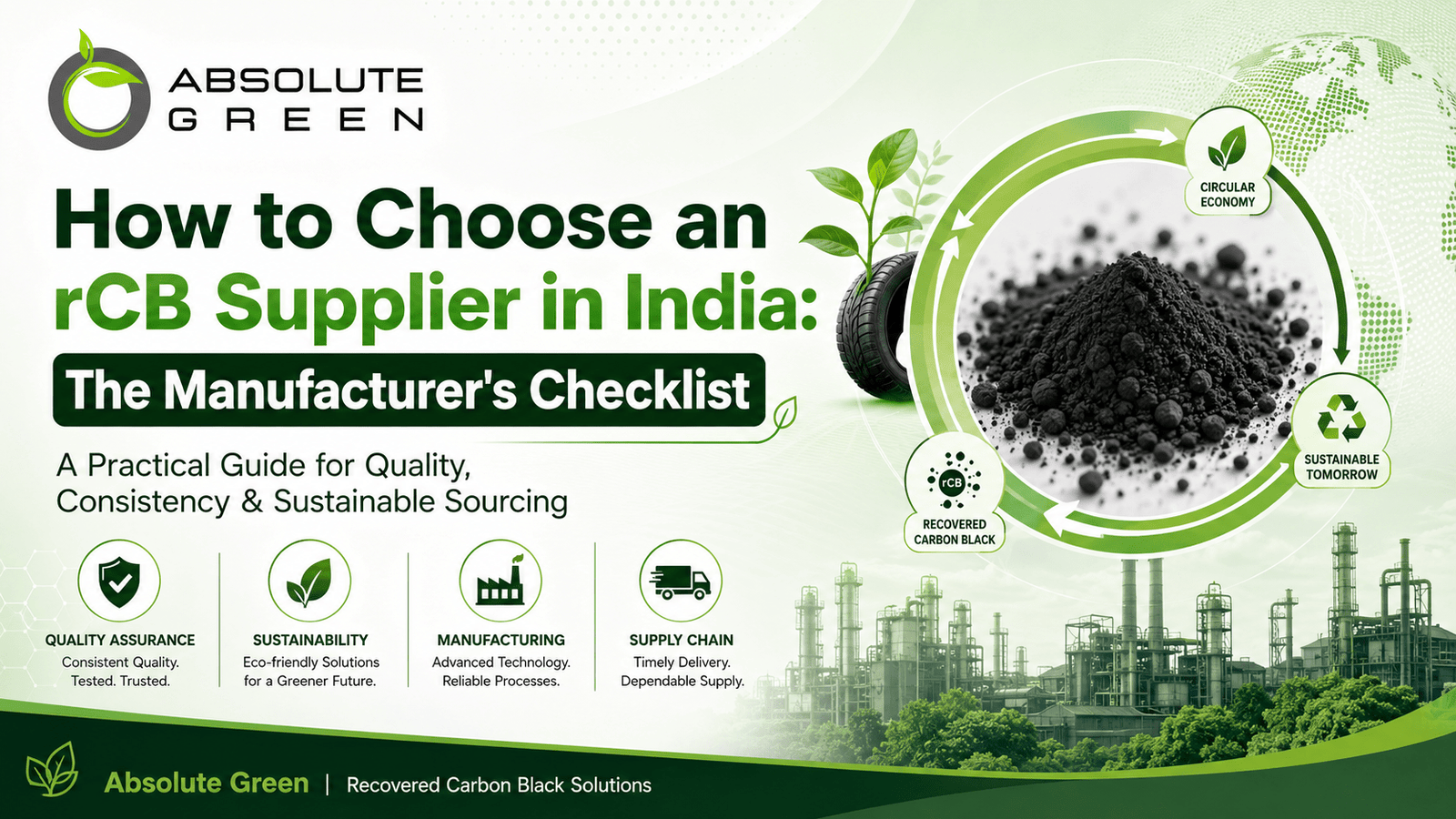
Choose an rCB supplier in India based on six core criteria: batch-to-batch consistency backed by test data, transparent technical data sheets, production capacity and supply reliability, quality control infrastructure, feedstock traceability, and commercial terms including pricing and logistics. Prioritize manufacturers over traders, request samples for compound trials before committing, and verify consistency across multiple batches rather than a single sample. A reliable supplier provides full documentation and technical support.
Why Supplier Selection Matters More for rCB Than Virgin Carbon Black
Virgin carbon black is a mature, standardized product. Grades are tightly controlled, specifications are predictable, and most suppliers deliver consistent quality. rCB is different.
Because rCB is produced from end-of-life tyres, its quality depends heavily on feedstock sourcing, pyrolysis technology, and post-processing capability — all of which vary widely across the Indian market. This variability creates real risk:
- A supplier with poor feedstock control delivers rCB with fluctuating ash and sulfur content
- A supplier without proper post-processing delivers material that disperses poorly
- A supplier without quality testing cannot guarantee what is actually in each batch
- A trader (rather than a manufacturer) has no control over any of these factors
The result is that supplier selection has a much larger impact on outcomes with rCB than with virgin carbon black. Getting it right is not optional — it is the foundation of successful rCB adoption.
Looking for a Reliable rCB Supplier in India?
Absolute Green provides high-quality Recovered Carbon Black (rCB) with consistent quality, sustainable manufacturing, and dependable supply for industries across India.
📞 Call Us: +91 92059 30015 Request a SampleSpeak with our experts to discuss your specifications, pricing, and supply requirements.
The Complete rCB Supplier Evaluation Checklist
Use these criteria to systematically evaluate any rCB supplier in India.
1. Manufacturer vs Trader
The first and most important distinction.
- Manufacturers control feedstock, process, and quality. They can adjust grades, guarantee consistency, and provide technical support.
- Traders buy and resell material they don’t produce, with limited control over quality or consistency.
Always prioritize buying directly from a manufacturer. Ask directly: “Do you operate your own pyrolysis and processing facility?” A genuine manufacturer will welcome a plant visit or virtual tour.
2. Batch-to-Batch Consistency
This is the single most important quality factor for rCB.
Request:
- Specification ranges (not just typical values) for key parameters
- Test data across multiple recent batches
- Standard deviation or variability data for ash content, iodine number, and OAN
- The supplier’s process for handling out-of-spec material
A reliable supplier tracks and documents consistency. If a supplier can only provide a single “typical” data sheet with no batch history, treat it as a warning sign.
3. Transparent Technical Data Sheets
A complete technical data sheet should include:
- Iodine adsorption number (with range)
- Oil absorption number / OAN (with range)
- Ash content (typical and maximum)
- Sulfur content
- Volatile matter and moisture
- pH
- Pour density (for pelletized grades)
- Sieve residue / mesh analysis
- Suggested N-series equivalence
- Heating loss
If a supplier is reluctant to share full specifications, that lack of transparency is itself disqualifying.
4. Quality Control Infrastructure
Ask about the supplier’s testing capability:
- Do they have an in-house quality control laboratory?
- What parameters do they test on every batch?
- Do they provide a Certificate of Analysis (CoA) with each shipment?
- Are they willing to do third-party testing if requested?
In-house testing capability signals a serious manufacturer committed to consistent quality.
5. Feedstock Sourcing and Traceability
The quality of rCB starts with the quality of the input tyres.
- Does the supplier have a stable, contracted feedstock supply?
- Can they segregate feedstock by tyre type for consistency?
- Do they comply with EPR (Extended Producer Responsibility) regulations for waste tyre processing?
- Can they demonstrate traceability of their feedstock?
Stable feedstock sourcing directly translates to stable product quality.
6. Production Capacity and Supply Reliability
Evaluate whether the supplier can actually meet your needs:
- What is their monthly production capacity?
- Can they scale with your demand?
- What are their typical lead times?
- How do they handle supply disruptions?
- Do they hold buffer inventory?
A supplier near capacity may struggle to deliver consistently as your orders grow.
7. Product Forms and Grade Range
Confirm they offer what your application requires:
- Powder, pelletized, or micronized forms
- Multiple grades matched to different N-series equivalents
- Application-specific grades if relevant
- Packaging options (25 kg bags, jumbo bags, bulk)
8. Commercial Terms and Pricing Transparency
Evaluate the full commercial picture, not just price per tonne:
- Transparent, volume-based pricing
- Flexible payment terms
- Clear delivery terms (ex-works, FOR destination)
- Long-term contract options for price and supply stability
- No hidden quality or logistics surcharges
9. Logistics and Location
Location affects landed cost and lead time significantly:
- Proximity to your manufacturing facility
- Regional logistics network
- Reliability of delivery
- For North and Central India buyers, a Hapur-based supplier offers meaningful freight and lead-time advantages
10. Technical Support and Partnership
The best suppliers act as partners, not just vendors:
- Do they provide formulation and loading-level guidance?
- Will they support compound trials?
- Do they offer cure system adjustment recommendations?
- Are they responsive to technical queries?
Supplier Evaluation Scorecard
Use this scorecard to compare rCB suppliers objectively. Rate each criterion and compare totals.
| Criterion | Weight | What to Look For |
| Manufacturer (not trader) | High | Owns pyrolysis + processing facility |
| Batch consistency | High | Multi-batch test data, spec ranges |
| Technical documentation | High | Complete TDS + Certificate of Analysis |
| Quality control | High | In-house lab, per-batch testing |
| Feedstock traceability | Medium | Stable, segregated, EPR-compliant supply |
| Production capacity | Medium | Capacity headroom, reliable lead times |
| Grade range and forms | Medium | Matches your application needs |
| Commercial terms | Medium | Transparent pricing, contract options |
| Logistics / location | Medium | Regional advantage, reliable delivery |
| Technical support | High | Active formulation and trial support |
Weight the “High” criteria most heavily — they are the factors most likely to affect your production outcomes.
Red Flags to Watch For
Certain signals should make you cautious about an rCB supplier.
- Reluctance to share specifications — transparency is non-negotiable
- Only “typical” data, no batch history — suggests no consistency tracking
- No in-house testing — cannot guarantee what’s in each batch
- Unwillingness to provide samples — confident suppliers welcome trials
- Prices significantly below market — often signals quality or consistency problems
- No technical support capability — indicates a trader, not a manufacturer
- Vague feedstock sourcing answers — points to inconsistent input quality
- No plant or facility verification — genuine manufacturers are transparent about operations
A single red flag isn’t always disqualifying, but multiple flags together signal real risk.
The Sample and Trial Process
Never commit to a large order without validating the material first. Follow this process:
Step 1: Request a Representative Sample
Ask for a sample from current production, accompanied by the batch’s Certificate of Analysis.
Step 2: Verify Specifications
Independently test the sample (or have it tested) for ash content, iodine number, OAN, and other key parameters. Confirm they match the supplier’s claims.
Step 3: Run a Compound Trial
Test the rCB in your actual formulation on production-scale equipment. Evaluate:
- Dispersion and mixing behavior
- Cure characteristics
- Mechanical properties (tensile, elongation, abrasion, tear)
- Comparison against your current carbon black
Step 4: Request a Second Batch
This is the step most buyers skip — and it matters most. Request a second sample from a different production batch and verify consistency. Single-batch quality means little if the supplier cannot replicate it.
Step 5: Start with a Pilot Order
Begin with a modest order before committing to a long-term contract. Validate consistency, lead times, and service quality at smaller scale.
Questions to Ask Every rCB Supplier
Bring this list to your supplier conversations:
- Do you manufacture rCB in your own facility, or do you resell?
- What is your monthly production capacity?
- Can you share technical data sheets for all your grades?
- Do you provide a Certificate of Analysis with each batch?
- What are your specification ranges for ash, iodine number, and OAN?
- Can you provide test data across multiple recent batches?
- Where does your feedstock come from, and is it segregated?
- Are you EPR-compliant for waste tyre processing?
- What product forms and grades do you offer?
- What are your standard lead times and minimum order quantities?
- Do you offer long-term supply contracts?
- What technical support do you provide for compound trials?
- Can you supply a sample for our evaluation?
The quality and confidence of the answers will tell you a great deal about the supplier.
Why Buyers Choose Absolute Green Carbon
Absolute Green Carbon (Absolute Green Polymers Pvt. Ltd.) is a manufacturer, not a trader. Operating from Hapur, Uttar Pradesh, the company controls its production process from feedstock through finished product, which is the foundation of consistent quality.
For industrial buyers evaluating rCB suppliers in India, Absolute Green Carbon offers:
- Manufacturer-direct supply with full control over feedstock and process
- Batch-to-batch consistency documentation and quality control
- Complete technical data sheets with specification ranges and N-series equivalence guidance
- Sample programs for compound trials and qualification
- Multiple grades and forms matched to different applications
- Technical support for formulation, loading levels, and cure system adjustment
- Regional logistics advantages for North, Central, and Western India
- Flexible commercial terms including long-term supply agreements
The company’s location in Hapur places it within efficient reach of the Delhi-NCR, Punjab, Haryana, and Western UP industrial corridors, reducing freight costs and lead times for a large base of Indian rubber and polymer manufacturers.
Frequently Asked Questions
Start by prioritizing manufacturers over traders, then evaluate batch-to-batch consistency, technical documentation, quality control infrastructure, and feedstock traceability. Request samples for compound trials, verify consistency across multiple batches, and start with a pilot order before committing to a long-term contract.
A complete rCB technical data sheet should include iodine number, oil absorption number (OAN), ash content, sulfur content, volatile matter, moisture, pH, pour density, sieve residue, and suggested N-series equivalence. Each parameter should show specification ranges, not just typical values.
Buy from a manufacturer whenever possible. Manufacturers control feedstock, production, and quality, allowing them to guarantee consistency and provide technical support. Traders resell material they don’t produce and have limited control over quality or batch-to-batch consistency.
Request a representative sample with its Certificate of Analysis, independently verify the specifications, and run a compound trial in your actual formulation on production equipment. Critically, request a second sample from a different batch to confirm consistency before committing to large orders.
Batch-to-batch consistency is the most important factor. Because rCB quality varies with feedstock and process control, a supplier that delivers consistent specifications across multiple batches eliminates most compounding problems. Consistency matters even more than the lowest price per tonne.
Yes. ASTM D8178 is the international standard for terminology and classification of recovered carbon black, and many quality-focused Indian manufacturers reference it. Suppliers should also be compliant with EPR (Extended Producer Responsibility) regulations for waste tyre processing.
Location affects landed cost and lead times. Logistics is a meaningful component of delivered rCB price, so sourcing from a regionally located manufacturer reduces freight costs and improves delivery reliability. For North and Central India buyers, a Hapur-based supplier like Absolute Green Carbon offers clear advantages.
Ask whether they manufacture or resell, their production capacity, whether they provide technical data sheets and Certificates of Analysis, their specification ranges, feedstock sourcing and EPR compliance, available grades and forms, lead times, contract options, and what technical support they provide. Request a sample for evaluation.
Partner with a Trusted rCB Manufacturer in India
Choosing an rCB supplier is a decision that affects your input costs, product quality, and supply security for years. The framework in this checklist — prioritizing manufacturers, demanding consistency and transparency, and validating through trials — protects you from the risks that come with an immature market and helps you build a reliable, long-term sourcing relationship.
Absolute Green Carbon, a division of Absolute Green Polymers Pvt. Ltd., is a leading manufacturer and supplier of recovered carbon black in India, operating from Hapur, Uttar Pradesh. We support industrial buyers with manufacturer-direct supply, complete technical documentation, batch consistency, sample programs, and hands-on technical support.
To request technical data sheets, an evaluation sample, or a commercial quotation, connect directly with the Absolute Green Carbon team. Rubber compounders, tyre manufacturers, polymer processors, and procurement teams evaluating rCB suppliers in India are welcome to start a conversation.