If you’re in rubber compounding, you’ve probably had this conversation already this year. Procurement walks over and asks whether you can swap in some recovered carbon black (rCB) for your virgin N330 without blowing up your specs. It’s a fair question, and honestly, it’s not going anywhere. Tyre makers and industrial rubber producers are under real pressure to work recycled inputs into their formulations, and rCB is almost always the first thing that comes up.
So here’s the honest answer: it depends. Where in the compound are you putting it? Which rCB grade are you actually sourcing? How much performance cushion does your application give you to work with? Those three questions decide everything. This article walks through where rCB genuinely holds its own against N330, and where — despite what some suppliers will tell you — it still comes up short.
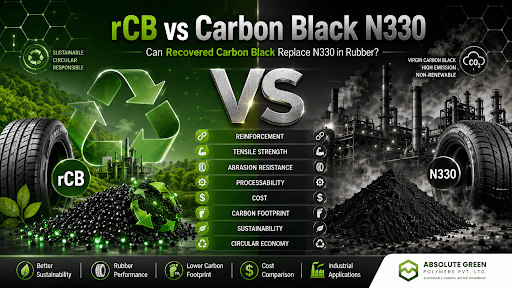
rCB vs N330 at a Glance
| Parameter | Carbon Black N330 (Virgin) | Recovered Carbon Black (rCB) |
| Source | Petroleum-based furnace process | Pyrolysis of end-of-life tyres/rubber |
| Particle size consistency | Highly uniform, ASTM controlled | Varies by feedstock and process |
| Surface area | Consistent, well-documented | Can vary batch to batch |
| Ash content | Very low | Higher, depends on feedstock |
| Tensile strength contribution | Strong, predictable | Moderate to good, grade-dependent |
| Abrasion resistance | Excellent | Good, but generally below N330 |
| Dispersion | Predictable | Requires more process control |
| Cost | Higher, tied to oil prices | Generally lower |
| Sustainability profile | Higher carbon footprint | Lower carbon footprint, diverts waste tyres |
| Best fit | High-performance, safety-critical parts | Non-critical or partially-loaded compounds |
What Is Carbon Black N330?
N330 is one of the most widely used furnace carbon blacks in the rubber industry. It’s classified under ASTM standards (the “N” series covers furnace blacks with normal curing behavior) and sits in a sweet spot between reinforcement and processability.
You’ll find N330 in tyre treads, sidewalls, conveyor belts, hoses, and a long list of mechanical rubber goods. It’s popular because it gives a reliable balance of tensile strength, abrasion resistance, and modulus, without being as aggressive on processing as finer grades like N220. Formulators trust it because the particle size and structure are tightly controlled batch after batch — you know what you’re getting.
What Is Recovered Carbon Black (rCB)?
rCB is produced by pyrolyzing end-of-life tyres and other rubber scrap. Heat breaks the material down in a low-oxygen environment, separating out oil, gas, steel, and a solid carbon residue. That residue is processed further — milled, sometimes pelletized — into what the industry calls rCB.
Unlike N330, rCB isn’t made to a single tight specification. It’s produced from whatever tyres go into the reactor, and different pyrolysis operators use different processes and post-treatment steps. That’s the single biggest thing buyers need to understand: rCB is not one material, it’s a category, and grade quality varies a lot between suppliers.
Manufacturing Process Comparison
N330 comes from the furnace black process — burning heavy petroleum feedstock in a controlled reactor to produce carbon black with a specific particle size and structure. It’s a mature, well-understood process with decades of process refinement behind it.
rCB comes from pyrolysis, which is fundamentally a recycling process rather than a manufacturing process built around a target specification. The feedstock (scrap tyres) already contains carbon black mixed with residual rubber, mineral fillers, zinc oxide, and other compounding chemicals. Pyrolysis recovers carbon-rich char, but that char inherently carries some of these residuals along with it — which is why ash content and surface chemistry tend to run higher and less consistent than virgin grades.
This difference in manufacturing origin is the root cause of almost every performance gap you’ll see between rCB and N330.
Performance Comparison
Mechanical Properties
N330 delivers dependable reinforcement across a wide range of rubber compounds. It has a well-established structure and surface activity that interacts predictably with rubber polymer chains, giving formulators confidence in the final mechanical output.
rCB can approach these numbers in certain applications, especially at partial loading levels, but the mechanical output depends heavily on the feedstock tyres and the pyrolysis process used. Some premium rCB grades from established suppliers get close to N550 or N330-level performance in specific compounds. Lower-grade rCB tends to underperform noticeably.
Tensile Strength
This is usually where the gap shows up first. Virgin N330 gives formulators a known tensile strength contribution because the particle size distribution is tight. rCB’s tensile contribution tends to be lower and more variable, largely because of residual impurities and less uniform particle structure.
In practice, many compounders find they can replace 10–30% of N330 with rCB in non-critical parts without a major tensile hit. Pushing beyond that usually means retesting and reformulating.
Abrasion Resistance
Abrasion resistance is one of N330’s strong points, which is exactly why it shows up in tread compounds and other high-wear parts. rCB generally lags here. The variability in particle size and surface characteristics means the rubber-filler interaction isn’t as tight, so wear resistance tends to drop as rCB content increases.
For non-tread applications — mats, gaskets, low-wear mechanical goods — this gap matters a lot less.
Dispersion
Good dispersion means the filler distributes evenly through the rubber matrix instead of clumping. N330 disperses predictably because its particle size is consistent from batch to batch.
rCB dispersion is more sensitive to mixing time, temperature, and shear. Some rCB grades need adjusted mixing cycles to avoid agglomerates that show up as weak points or surface defects in the final part. This is one of the practical adjustments compounders need to plan for, not just accept as a limitation.
Processability
N330 behaves consistently on the mill and in the internal mixer, which keeps cycle times predictable. rCB can behave differently — sometimes it processes fine, sometimes it increases mixing torque or extends cycle time depending on ash and residual oil content. It’s not a dealbreaker, but it’s a variable that plant engineers need to account for in scheduling and energy costs.
Cost Comparison
Virgin carbon black prices track petroleum feedstock costs, so N330 pricing can swing with oil markets. rCB is generally priced lower and tends to be more stable, since it’s tied to tyre recycling volumes rather than crude oil.
That said, cost comparisons aren’t just about price per kilogram. If a lower rCB loading forces a reformulation, extra testing, or slightly reduced part life, the “cheaper” material can end up costing more once you factor in engineering time and warranty risk. Procurement teams need to look at total cost of ownership, not just the invoice.
Sustainability Comparison
This is where rCB has a clear advantage. Producing rCB through pyrolysis diverts scrap tyres from landfill or stockpiling, and the process generally has a smaller carbon footprint than manufacturing virgin carbon black from petroleum. For manufacturers under pressure to report on Scope 3 emissions or meet customer sustainability requirements, rCB is a meaningful lever.
Organizations like ETRMA have highlighted end-of-life tyre recycling as a priority for the European rubber industry, and several major tyre makers, including Continental and Michelin, have published sustainability commitments that reference recovered materials as part of their roadmap toward reducing dependence on virgin raw materials.
Advantages of rCB
- Lower carbon footprint compared to virgin carbon black manufacturing
- Diverts end-of-life tyres from landfill and stockpiling
- Generally lower and more stable cost
- Supports sustainability certifications and ESG reporting
- Works well in non-critical or partially-loaded compounds
- Reduces dependence on petroleum-linked raw materials
Limitations of rCB
- Batch-to-batch variability depending on feedstock and supplier
- Lower tensile strength and abrasion resistance versus N330 in most cases
- Higher ash content can affect long-term part performance
- Requires more careful process control during mixing
- Not all rCB grades are interchangeable — testing each supplier’s material is essential
- Limited track record in safety-critical, high-load applications
Can rCB Completely Replace N330?
Right now, full replacement isn’t realistic for most demanding applications, and any formulator who tells you otherwise probably hasn’t run the abrasion tests yet. Where rCB performs well is in partial substitution — blending it with virgin N330 to bring down cost and carbon footprint while keeping mechanical properties within acceptable limits.
For tread compounds and other high-load, high-wear parts, most manufacturers are still cautious about pushing rCB content too high. For sidewalls, inner liners, mechanical rubber goods, and lower-stress parts, higher substitution rates are more workable.
The practical approach most experienced compounders take is incremental: start with a low substitution rate, run full mechanical and durability testing, and step up the rCB percentage only as data supports it. Skipping that validation step is where problems show up later — in the field, not in the lab.
When Should Manufacturers Use rCB?
- When the application isn’t safety-critical or doesn’t demand top-tier abrasion resistance
- When sustainability reporting or customer ESG requirements are driving material decisions
- When cost stability matters more than squeezing out the last percentage point of performance
- When there’s time and budget to run proper validation testing before scaling up
- When working with an established rCB supplier that can show consistent quality data, not just a spec sheet
Industry Applications
Where N330 dominates: tyre treads, sidewalls (in blends), conveyor belts, high-performance mechanical rubber goods, and any part where predictable abrasion resistance is non-negotiable.
Where rCB is gaining ground: rubber mats, low-load mechanical parts, some inner liner formulations, masterbatch blends, non-tyre industrial rubber products, and compounds where partial substitution meets sustainability targets without compromising the part’s core function.
[Internal Link: Rubber Industry Applications]
Frequently Asked Questions
1. Is rCB as strong as N330?
Not consistently. Premium rCB grades can come close in specific compounds, but most rCB shows lower tensile strength and abrasion resistance than virgin N330, especially at higher loading levels.
2. What percentage of N330 can be replaced with rCB?
It varies by application, but many manufacturers start in the 10–30% substitution range for non-critical parts and adjust based on testing results.
3. Does rCB meet ASTM standards like N330?
rCB doesn’t have the same standardized ASTM classification system that virgin carbon black grades like N330 do. Reputable suppliers test and characterize their rCB against ASTM methods such as ASTM D1765, but quality still varies by producer.
4. Why is rCB cheaper than N330?
rCB pricing isn’t tied to crude oil the way virgin carbon black is, and it uses recycled tyre feedstock rather than raw petroleum, which generally keeps costs lower and more stable.
5. Is rCB suitable for tyre treads?
Currently, most manufacturers use rCB cautiously in tread compounds, often in blends with virgin carbon black, because abrasion resistance requirements are strict for that application.
6. Does rCB affect rubber processing?
It can. Some rCB grades increase mixing torque or require adjusted mixing cycles due to higher ash content and residual impurities from the feedstock tyres.
7. How do I know if an rCB supplier’s material is reliable?
Ask for batch consistency data, ash content specs, and third-party test results, not just a general product datasheet. Running your own trial batches before committing to volume is standard practice.
8. Will rCB eventually replace virgin carbon black entirely?
It’s unlikely in the near term for high-performance applications, but as pyrolysis technology and quality control improve, rCB’s role in rubber compounds is expected to grow steadily.
Final Verdict
rCB isn’t a drop-in replacement for N330, and treating it that way is how compounds fail in the field. But it’s also not a compromise material to avoid altogether. Used strategically — in the right applications, at the right substitution rate, with proper testing — rCB gives manufacturers a real way to cut costs and improve sustainability metrics without gutting performance.
The manufacturers getting the most out of rCB right now are the ones who treat it as a formulation project, not a straight material swap. That means testing multiple suppliers, running full mechanical and durability panels, and building substitution rates up gradually instead of jumping straight to a high percentage.
Conclusion
The rCB vs N330 question isn’t really about which material is “better” — it’s about matching the right material to the right part of your compound. N330 still leads on consistency and top-end performance. rCB leads on cost and sustainability, and it’s closing the performance gap faster than most people expect.
If you’re evaluating rCB for your next formulation, the smartest first step is small-batch testing against your current N330 baseline before committing to a supplier or a substitution rate.
Talk to our compounding team about testing rCB in your rubber formulation — get a sample evaluation and side-by-side performance data before you scale up.