Table of Contents
- What Is Recovered Carbon Black?
- What Is Virgin Carbon Black?
- Recovered Carbon Black vs Virgin Carbon Black
- How rCB Performs in Rubber Compounds
- Why Manufacturers Are Choosing rCB
- Can rCB Replace Virgin Carbon Black?
- Industries Using rCB
- Environmental Benefits
- How to Choose the Right Grade
- FAQs
- Conclusion
Rubber manufacturers are under pressure to cut costs, meet sustainability targets, and still deliver products that perform. That’s why so many compounders are now testing recovered carbon black for rubber as an alternative to the material they’ve used for decades.
This question comes up constantly in technical meetings and supplier calls. Plant managers want to know if switching will hurt tensile strength. Purchasing teams want to know if they can hit ESG goals without sacrificing quality. R&D teams need real data, not marketing claims.
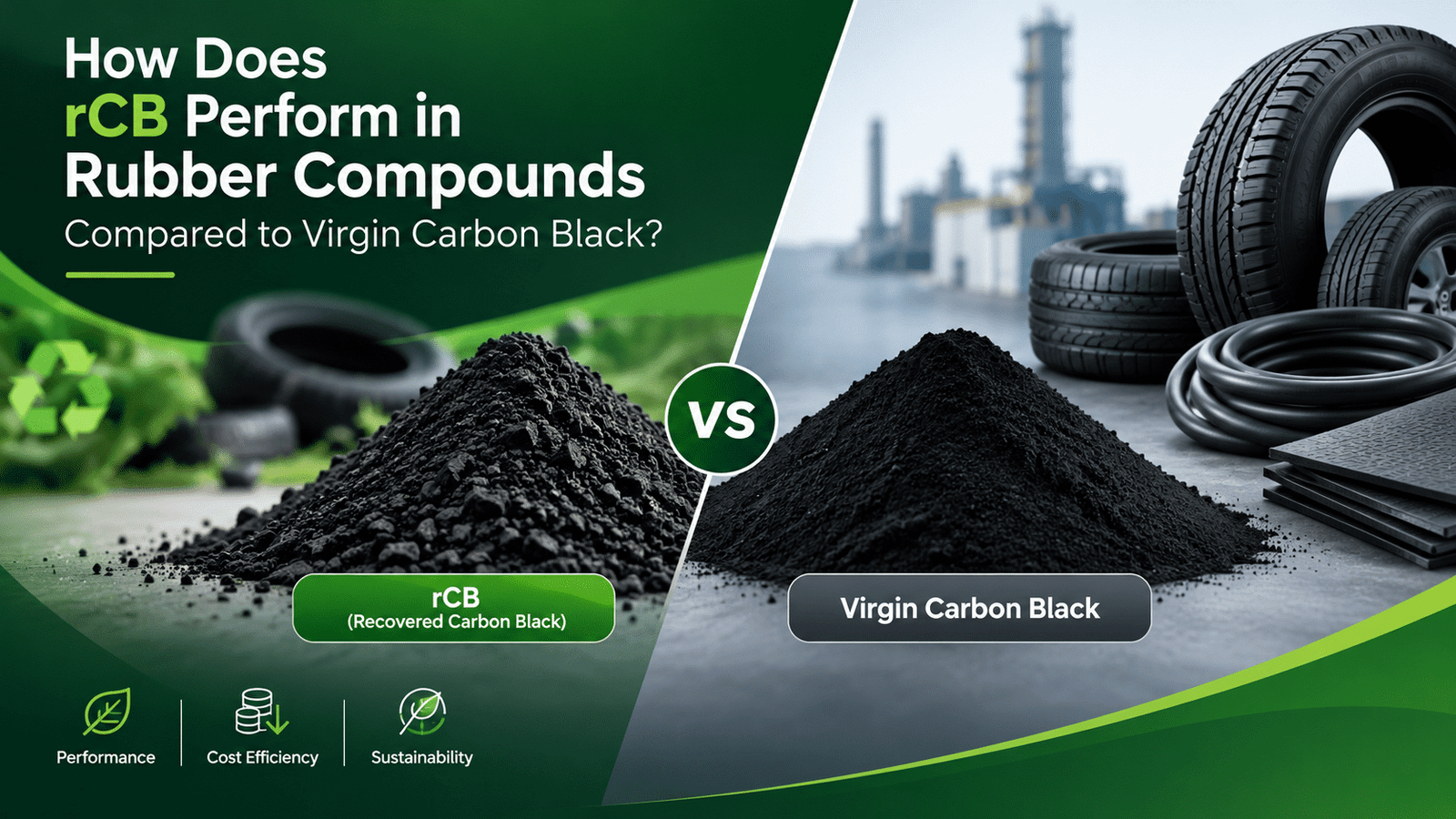
Recovered carbon black (rCB) generally performs close to virgin carbon black in lower-stress rubber parts, but shows more variation in tensile strength, abrasion resistance, and dispersion. Performance depends heavily on rCB grade, feedstock quality, and post-processing — not simply on whether the material is recycled.
This article breaks down how rCB performs against virgin carbon black across the properties that matter most in rubber compounds — reinforcement, strength, abrasion resistance, processing, and cost.
What Is Recovered Carbon Black?
Recovered carbon black, often shortened to rCB, is made by breaking down scrap tires and other rubber waste through a process called tire pyrolysis. Instead of sending old tires to landfills, manufacturers heat them in an oxygen-limited chamber.
This breaks the rubber down into oil, gas, steel, and a solid carbon residue. That residue is refined further through grinding, screening, and sometimes chemical treatment to become rCB.
The end result is a black powder that looks similar to virgin carbon black and can be used for many of the same jobs in rubber compounds.
Whether rCB is more cost-effective than virgin material depends on several factors. Supplier quality, processing standards, and current market pricing for petroleum feedstocks all play a role. In some markets rCB offers a clear cost advantage; in others, the gap is narrower once quality control and testing costs are factored in.
The biggest technical difference between rCB and virgin carbon black comes down to consistency. Because rCB is recovered from used tires, it can carry small amounts of ash, sulfur, and mineral impurities left over from the original rubber compound. Virgin carbon black doesn’t face this issue, since it comes from a controlled feedstock from the start.
It’s also worth noting that rCB is not a single, uniform product. Performance varies by grade, feedstock quality, and how much post-processing a supplier applies — not just because the material is recycled.
What Is Virgin Carbon Black?
Virgin carbon black is produced through the furnace black process using heavy petroleum feedstocks in an oxygen-limited environment. This method has been the industry standard for over a century.
The furnace process lets manufacturers control particle size and structure with a high degree of precision. That control is why virgin carbon black comes in dozens of standardized grades, including N110, N220, N330, N550, and N660.
Each grade suits a different job in rubber manufacturing:
- Smaller particle grades like N220 give higher reinforcement, common in tire treads
- Larger particle grades like N660 give better processing, common in sidewalls and hoses
Virgin carbon black has stayed the industry standard because it delivers predictable, repeatable results batch after batch. That matters when a formulation has to pass strict safety and performance testing.
Recovered Carbon Black vs Virgin Carbon Black
Here’s a side-by-side comparison of the properties that matter most when evaluating recovered carbon black for rubber against virgin carbon black.
| Property | Recovered Carbon Black (rCB) | Virgin Carbon Black |
| Reinforcement | Moderate; varies by feedstock and process | High and consistent, grade-dependent |
| Tensile strength | Generally lower, narrows with post-processing | Higher and more predictable |
| Abrasion resistance | Fair to good, depends on purity | Excellent, especially in tread-grade material |
| Dispersion | Can be uneven due to residual contaminants | Very uniform and easy to disperse |
| Ash content | Higher and more variable; a common buyer concern | Low and tightly controlled |
| Batch consistency | Varies more between suppliers and lots | Highly consistent, industry-standard |
| Surface area | Lower on average, affects reinforcement | Higher in fine grades, boosts reinforcement |
| Iodine number | Variable; useful metric for comparing purity | Standardized per grade |
| Processing | May need adjusted mixing cycles | Well-understood, standard processing |
| Cost | Often lower, but depends on supplier and market | Typically higher, tied to petroleum prices |
| Sustainability | Strong; reduces tire waste and emissions | Lower; relies on virgin fossil feedstock |
| Typical applications | Non-tread rubber goods, blends, industrial parts | Tire treads, high-performance rubber products |
Expert Insight
Most rubber manufacturers do not evaluate rCB by price alone. They compare ash content, surface area, iodine number, dispersion, and mechanical test results before approving a formulation for production.
How Recovered Carbon Black Performs in Rubber Compounds
Reinforcement
rCB typically offers moderate reinforcement compared to virgin carbon black, though high-quality grades can close much of the gap.
Reinforcement is about how much a filler strengthens the rubber matrix. Virgin carbon black grades are engineered for specific particle sizes, giving compounders precise control over reinforcement level.
rCB particles tend to be less uniform in size. They can also carry residual rubber or mineral content from the original tire. This usually means lower reinforcement compared to an equivalent virgin grade, though results vary a lot between suppliers.
Tensile Strength
Compounds made with virgin carbon black generally test higher for tensile strength than those made with 100% rCB.
Tensile strength measures how much force a rubber compound can take before it tears apart. In side-by-side tests using methods like ASTM D412, virgin carbon black compounds typically outperform full rCB compounds.
That gap narrows when rCB is refined further or blended with virgin material. Many manufacturers achieve acceptable tensile results using rCB in partial replacement ratios rather than full replacement.
Abrasion Resistance
Virgin carbon black, especially fine grades, generally outperforms rCB in abrasion resistance testing.
Abrasion resistance is critical for products that face constant friction, such as tire treads, conveyor belts, and rubber mats. Testing methods like ASTM D5963 are commonly used to measure this property.
rCB can deliver reasonable abrasion resistance in lower-demand applications. It generally falls short in high-wear parts like tire treads, which is why most current rCB use focuses on parts facing less mechanical stress.
Dispersion
rCB dispersion is typically less uniform than virgin carbon black due to residual ash and mineral content.
Dispersion refers to how evenly the carbon black particles spread through the rubber during mixing. Poor dispersion creates weak spots and inconsistent properties across a finished product.
Virgin carbon black disperses predictably because its particle size and surface chemistry are tightly controlled. rCB can be trickier to mix evenly, though better producers address this with additional grinding and purification steps.
Heat Resistance
rCB generally performs adequately under moderate heat, but long-term data is more limited than for virgin carbon black.
Rubber parts in engines, tires, and industrial machinery need to hold up under heat without breaking down. Virgin carbon black has decades of documented, stable performance across a wide temperature range.
rCB heat performance is improving as processing methods advance. Manufacturers working with heat-exposed parts should still validate rCB formulations through their own lab testing before committing to production.
Aging Performance
Virgin carbon black has a longer, better-documented aging track record than rCB, though early rCB data looks promising for non-critical parts.
Aging performance looks at how a rubber compound holds up over months or years — resisting cracking, hardening, or loss of elasticity. The industry has studied virgin carbon black compounds for decades.
rCB aging data is growing but still more limited. Manufacturers making safety-critical rubber products typically run their own long-term aging tests before adopting rCB at scale.
Why More Manufacturers Are Choosing Recovered Carbon Black for Rubber
Interest in recovered carbon black for rubber has grown well beyond sustainability marketing. Several practical business drivers are pushing adoption forward:
- ESG and sustainability goals — Using rCB helps manufacturers show measurable progress on emissions and waste reduction targets tied to corporate ESG reporting.
- Circular economy — rCB turns end-of-life tires into a usable raw material instead of waste, supporting broader circular economy commitments across the supply chain.
- Tire waste recycling — Every ton of rCB produced represents scrap tire material diverted from landfills, stockpiles, or open burning.
- Cost management — While cost-effectiveness depends on supplier and market conditions, rCB can offer a hedge against volatile petroleum-based feedstock pricing.
- Supply chain diversification — Sourcing part of a carbon black supply from rCB producers reduces reliance on a single feedstock type or region, adding flexibility during supply disruptions.
These drivers don’t replace the need for performance testing. But they explain why more compounders are willing to invest the time to qualify rCB for their formulations.
Can rCB Replace Virgin Carbon Black Completely?
Full replacement is possible in some low-demand rubber products, but partial replacement blended with virgin carbon black remains the more common approach.
Most manufacturers today use partial replacement rather than a full swap. Common blend ratios range from 10% to 50% rCB, depending on the application and performance requirements.
A rubber floor mat or a low-stress industrial gasket can often handle a higher rCB ratio than a tire tread or a high-pressure hose.
Several factors decide how much rCB a formulation can handle:
- The quality and consistency of the specific rCB grade
- The performance requirements of the final product
- Processing equipment and mixing capability
- Whether the product faces safety certification requirements
- Cost targets versus performance targets
Every formulation is different. A compound that works well with 30% rCB in one facility might need adjustment in another, simply due to differences in mixing equipment or base rubber polymer. This is why lab validation matters more than following a generic ratio.
Industries Using Recovered Carbon Black for Rubber
rCB adoption is growing across several sectors of rubber manufacturing, particularly where performance demands are moderate rather than extreme.
- Automotive — non-tread rubber parts like seals, gaskets, and vibration dampeners
- Conveyor belts — belt covers and backing layers in lower-stress industrial settings
- Rubber mats — flooring, agricultural mats, and anti-fatigue mats
- Hoses — outer covers and lower-pressure industrial hoses
- Industrial molded products — bushings, grommets, and general-purpose rubber goods
Tire treads remain the toughest application for rCB to break into. They demand the highest abrasion resistance and safety margins. Most tire manufacturers currently limit rCB use to sidewalls, inner liners, or small blend percentages within tread compounds.
Environmental Benefits
The sustainability case for rCB is one of its strongest selling points. Every ton of rCB used in rubber manufacturing is a ton of scrap tire material diverted from landfills or stockpiles.
Tire pyrolysis also recovers useful byproducts alongside rCB, including pyrolysis oil and recovered steel. This turns a single waste stream into three separate recovered resources.
Producing rCB generally requires less energy than manufacturing virgin carbon black from petroleum feedstock, which lowers the carbon footprint per ton of material. For companies working toward sustainable rubber manufacturing goals, this is often a deciding factor in testing rCB even before performance results are fully confirmed.
How to Choose the Right Grade
Picking the right rCB grade takes more homework than picking a standard virgin carbon black grade, simply because rCB quality varies more between suppliers.
A few practical steps help:
- Ask for a certificate of analysis covering ash content, particle size, surface area, and iodine number for every batch.
- Request samples before committing to volume orders, and run them through your own mixing and testing process.
- Match the grade to the application, not the price. Lower-cost rCB often carries higher ash content, which may be fine for a floor mat but risky for a load-bearing part.
- Check for batch consistency, since lot-to-lot variation is a bigger risk with rCB than with virgin material.
- Confirm compliance documentation, including ASTM D8178 classification, especially if the end product needs safety certification.
A good rCB supplier will welcome these questions. Suppliers who resist sharing batch data or test results are usually a sign of inconsistent quality.
Ultimately, no grade selection should skip lab testing. Manufacturers validate formulations through their own testing before moving to full production, regardless of how promising a supplier’s data sheet looks.
Frequently Asked Questions
Q1. Is recovered carbon black as strong as virgin carbon black?
Not usually, in direct comparisons. Virgin carbon black generally delivers higher tensile strength and abrasion resistance, though the gap narrows with high-quality rCB and blended formulations.
Q2. Can rCB be used in tire treads?
Only in small percentages so far. Tire treads demand the highest abrasion resistance and safety margins, so most manufacturers limit rCB to sidewalls, inner liners, or low-percentage tread blends.
Q3. What is a typical rCB replacement ratio?
Most manufacturers use rCB at 10% to 50% of total carbon black content, depending on the application and required performance. The right ratio depends on lab testing, not a fixed rule.
Q4. Does rCB cost less than virgin carbon black?
It often does, but cost-effectiveness depends on the supplier, processing quality, and current market conditions for petroleum feedstocks. It’s not a guaranteed savings in every case.
Q5. Is rCB regulated or standardized?
Yes. ASTM D8178 provides a classification system for recovered carbon black, helping buyers compare quality and specifications across suppliers.
Q6. Does rCB affect the color or appearance of rubber products?
Not significantly. rCB looks similar to virgin carbon black in finished rubber, though very high replacement ratios can sometimes cause slight surface texture differences.
Q7. Is rCB safe to use in industrial rubber products?
Yes, when it meets proper quality standards and testing. Manufacturers should still verify batch quality and run their own compatibility tests before full-scale production.
Q8. Why isn’t rCB used everywhere yet?
Consistency is the main barrier. Because rCB comes from recycled tires, its purity and particle characteristics vary more than virgin carbon black, which makes some manufacturers cautious about high-performance applications.
Conclusion
Choosing between recovered carbon black for rubber and virgin carbon black isn’t about picking a universal winner. It comes down to the product type, the performance requirements, the processing conditions in your facility, and how much weight your organization places on sustainability goals.
Virgin carbon black still leads in consistency, tensile strength, and abrasion resistance, especially for high-stress parts like tire treads. rCB holds up well in non-tread rubber products and blended formulations, and that performance gap keeps narrowing as pyrolysis and purification methods improve.
The practical takeaway is simple: test before you scale. Running trial batches, checking batch consistency, and validating against the right ASTM standards will tell you more about fit than any spec sheet or sales pitch.