Old tyres pile up everywhere, and most places still don’t have a good answer for what to do with them. Rubber sticks around for a long time before it breaks down naturally, so tyres end up sitting in landfills for years, stacked in stockpiles, or in the worst cases, burned out in the open where the smoke does real damage to air quality.
Recovered Carbon Black, or rCB as most people in the industry just call it, is one of the better answers to this. It’s a recycled material pulled out of old tyres and other rubber waste through a controlled heating process. What you get at the end is a black powder that can be cleaned up and used again in all kinds of industrial products. So rather than that rubber just sitting there taking up space, it actually gets a second life.
Manufacturers care about this more now than they used to, mostly because costs, resource efficiency, and sustainability all matter more than they did a decade ago. That’s part of why rCB has become such a useful secondary material for rubber, plastics, coatings, and a handful of other industries.
This article covers what recovered carbon black is, how it’s actually made, what it’s good for, where it comes up short, and the kinds of questions manufacturers tend to have before they start using it.
What Is Recovered Carbon Black (rCB)?
Carbon black itself isn’t new. It’s that fine black powder you find in rubber, plastics, inks, and coatings, and it’s there to add strength, durability, wear resistance, and color. Traditionally it comes from petroleum based feedstocks, which takes a decent amount of energy and fossil fuel to produce.
Recovered Carbon Black skips that route entirely. Instead of making fresh carbon black out of oil or gas, recycling plants pull the carbon that’s already sitting inside old tyres and rubber and refine it back into something usable.
Now, it’s not chemically identical to virgin carbon black, and nobody in the industry pretends it is. But it keeps hold of a lot of what actually matters, reinforcement, black pigmentation, added durability, decent resistance to heat and abrasion. That’s enough to make it work well in a lot of industrial and commercial settings, especially anywhere sustainability and cost are as important as raw performance.
How Is Recovered Carbon Black Produced?
Getting from a worn out tyre to usable rCB takes a few steps, and how good the end product is really comes down to the feedstock, the pyrolysis conditions, and what happens to the material afterward.
- Collecting the tyres. It all starts with used tyres coming in from retailers, workshops, fleet operators, scrap yards, and municipal collection programs. That’s the raw material for everything else.
- Shredding. The tyres get shredded down into smaller rubber chips. Smaller pieces are easier to work with, they open up more surface area, and they’re ready for the heat treatment that’s next.
- Pyrolysis. This is really the main event. The shredded rubber gets heated to high temperatures without any oxygen around, so instead of burning, the polymers just break down. Out of this one step you get pyrolysis oil, pyrolysis gas, steel wire, and a carbon rich solid residue, and that residue is the crude form of rCB.
- Separation. Magnetic and mechanical separation pulls the steel and other non carbon bits out, leaving the carbon on its own.
- Refining and milling. The crude stuff still has ash, minerals, and other impurities in it, so it goes through grinding, micronization, ash reduction, demineralization, and sometimes pelletization to get it clean.
- Testing and grading. Last step, the refined rCB gets tested for particle size, ash content, surface area, purity, reinforcement performance, and moisture. Based on how it performs, it gets sorted into grades and sent off to whatever application fits best.
Technical Characteristics of rCB
Even with a totally different production process behind it, recovered carbon black hangs onto most of what makes regular carbon black useful.
- Reinforcement. It adds real mechanical strength to rubber compounds, so finished products can take repeated stress and everyday wear without falling apart early.
- Black pigmentation. It gives that deep, even black color that’s needed for tyres, hoses, seals, molded rubber parts, and a lot of plastic products too.
- Heat and abrasion resistance. Products made with rCB tend to hold up better against heat, friction, and abrasion, which matters a lot in rougher industrial settings.
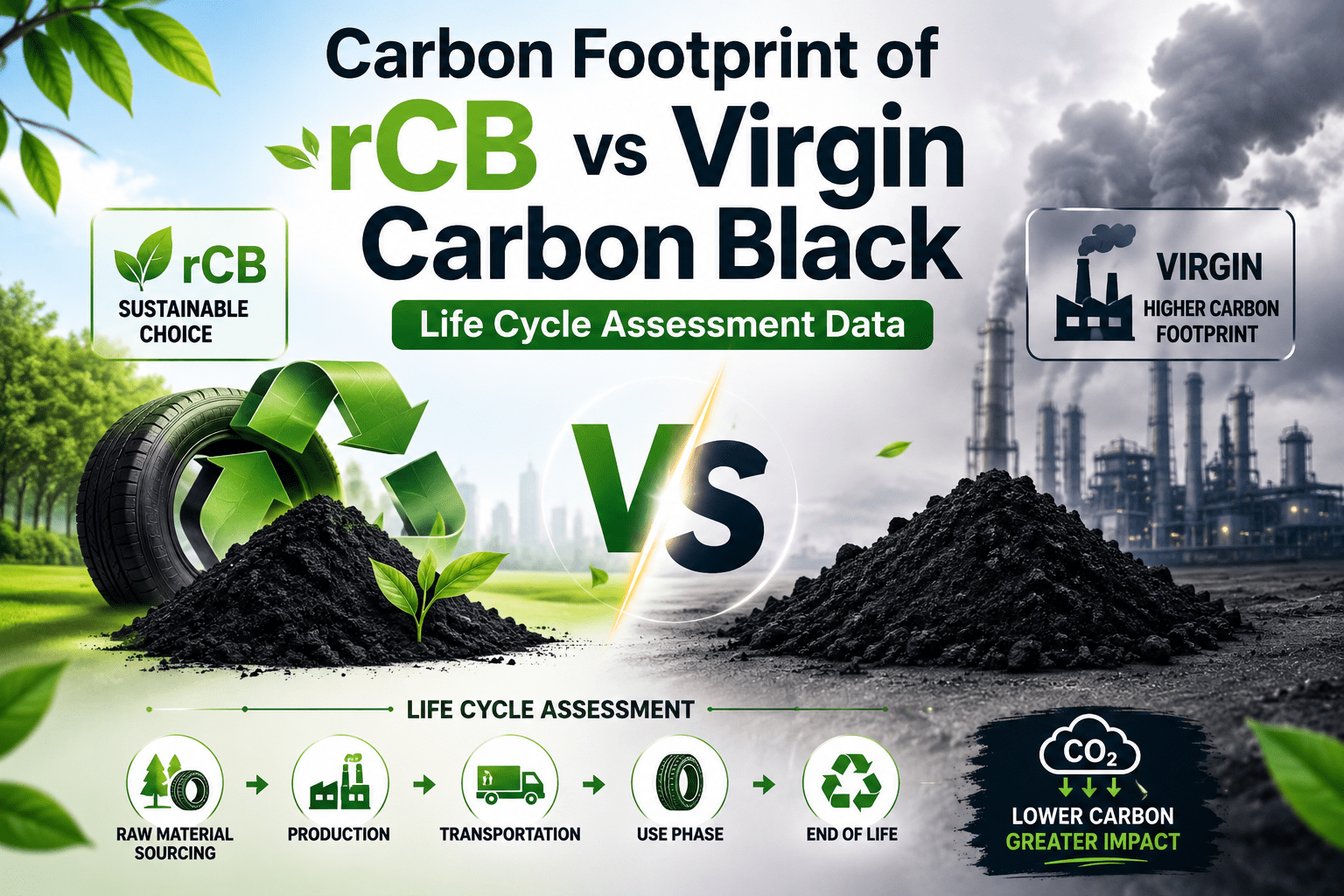
- A smaller environmental footprint. Since it comes from waste tyres rather than being made from scratch, using rCB helps cut down on landfill disposal, open tyre burning, and how much fresh fossil based carbon black gets made in the first place.
- Cost efficiency. For jobs that don’t need ultra high purity, rCB usually just costs less, and it doesn’t give up much performance to get there.
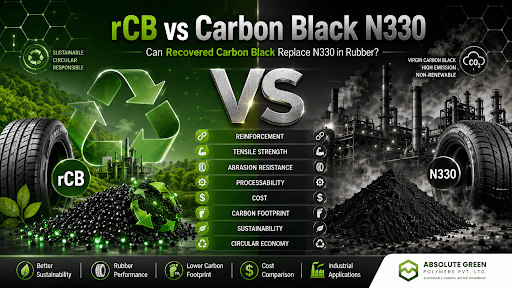
rCB vs Virgin Carbon Black
| Feature | Recovered Carbon Black (rCB) | Virgin Carbon Black |
| Source | Waste tyres and rubber | Petroleum-based feedstocks |
| Environmental impact | Lower | Higher |
| Ash content | Generally higher | Lower |
| Consistency | Can vary by feedstock | Highly consistent |
| Cost | Often lower | Usually higher |
| High-performance applications | Limited in some cases | Widely used |
Virgin carbon black still wins out in high performance tyres and specialty jobs where every single batch has to behave the same way. But for general industrial work, more and more manufacturers are turning to rCB instead.
Industrial Applications of Recovered Carbon Black
A large chunk of the rCB produced goes straight into tyre compounds and other rubber formulations, which is a simple way for manufacturers to work recycled material into new products.
Beyond tyres, it shows up in plenty of everyday rubber goods too. Conveyor belts, rubber mats, industrial hoses, gaskets, seals, and molded rubber parts all use it regularly.
It’s also making its way into plastics. In select products, it adds black coloration, some UV protection, and better wear resistance, and you’ll find it in pipes, containers, automotive parts, and construction grade plastics.
Some of the more heavily refined grades even end up in printing inks, coatings, and pigment systems, though those uses need much tighter quality control than most other applications.
And in construction, rubber flooring, roofing membranes, shock absorbing surfaces, and industrial protective materials all lean on rCB for extra durability.
Benefits of Using Recovered Carbon Black
Using rCB isn’t just about saving money, though that’s part of it. It cuts down on tyre waste in a very direct way, keeping millions of tyres out of landfills and away from illegal dumping. It also fits nicely into a more circular way of manufacturing, where material from old tyres gets pulled back into new products instead of being wasted for good.
Since it takes the place of some virgin carbon black, rCB also eases the demand on petroleum based raw materials, which is genuinely helpful for companies trying to hit their ESG and sustainability targets. And for a lot of non specialty jobs, it just costs less without really hurting product quality.
Limitations and Challenges
rCB isn’t a perfect one for one swap for virgin carbon black, and it’s worth being upfront about where it falls short.
Feedstock varies a fair bit since tyres aren’t all built the same, so the rCB that comes out can vary too, which makes it harder to guarantee the same result batch after batch. It also usually carries more ash and mineral residue than virgin carbon black, and in more sensitive formulations that can actually matter. Some applications need extra refining and stricter quality control just to bring rCB up to spec, which adds work and cost. And in high precision or high performance uses, virgin carbon black can still come out ahead on reinforcement, dispersion, and consistency.
That’s basically why manufacturers run compound testing and check performance carefully before they commit to rCB in full production.
Why Industries Are Adopting rCB
Companies are being pulled in a lot of directions at once these days. They need to cut waste, keep costs down, tighten up sustainability reporting, use more recycled content, and stay on the right side of environmental rules. Recovered carbon black happens to check several of those boxes at once. It takes a genuinely tough waste stream and turns it into a useful secondary raw material that fits into existing manufacturing setups without needing huge changes to the formulation in most cases.
And as pyrolysis and refining tech keeps getting better, the quality and consistency of commercial rCB keeps climbing too, which is only going to make it a more attractive option across more industries.
Typical rCB Production Flow

End-of-life tyres → Shredding → Pyrolysis → Separation of oil, gas, and steel → Crude rCB → Refining and milling → Quality testing → Industrial applications
Frequently Asked Questions (FAQs)
1. What’s the difference between recovered carbon black and virgin carbon black?
Virgin carbon black comes from petroleum based feedstocks. Recovered carbon black comes from used tyres and rubber waste run through pyrolysis. rCB tends to be the more sustainable choice, though it usually has more ash in it and behaves a little differently in some formulations.
2. Is rCB actually good for the environment?
For the most part, yes. It keeps old tyres out of landfills and reduces how much new fossil based carbon black needs to be made. How big that benefit really is depends a lot on how efficient the recovery and refining process is at whichever facility is producing it.
3. Can recovered carbon black be used in new tyres?
Yes, it can. It gets worked into select tyre compounds and other rubber formulations. How much gets used usually comes down to the performance needed, the quality specs involved, and the tyre maker’s own formulation standards.
4. What industries usually use rCB?
Mostly tyre manufacturing, rubber products, plastics, industrial hoses and seals, coatings and inks, and construction or flooring materials. The grade needed changes depending on what it’s going into.
5. Does using rCB actually save manufacturers money?
Often, yes, especially in applications that don’t need extremely high purity or specialized performance. Still, it’s worth weighing material performance, processing needs, and long term supply reliability before making it a permanent part of production.
Final Thoughts
Dealing with old tyres is a growing challenge for industries worldwide, and Recovered Carbon Black (rCB) offers a practical way to turn that waste into a valuable industrial resource.
Through controlled pyrolysis, refining, and quality testing, discarded tyres can be transformed into a carbon-rich material that still provides reinforcement, pigmentation, durability, and heat resistance. From tyres and rubber goods to plastics, coatings, and construction materials, rCB has established a meaningful role in resource-efficient manufacturing.
It may not replace virgin carbon black in every high-performance application, but for many industrial uses it provides a strong balance of sustainability, material recovery, and cost efficiency.
As industries continue moving toward lower waste generation and more circular production systems, recovered carbon black is expected to play an increasingly important role in sustainable manufacturing.
This article is published by Absolute Green Polymers as part of its ongoing effort to share practical knowledge on recycled materials, tyre derived resources, and sustainable industrial manufacturing.