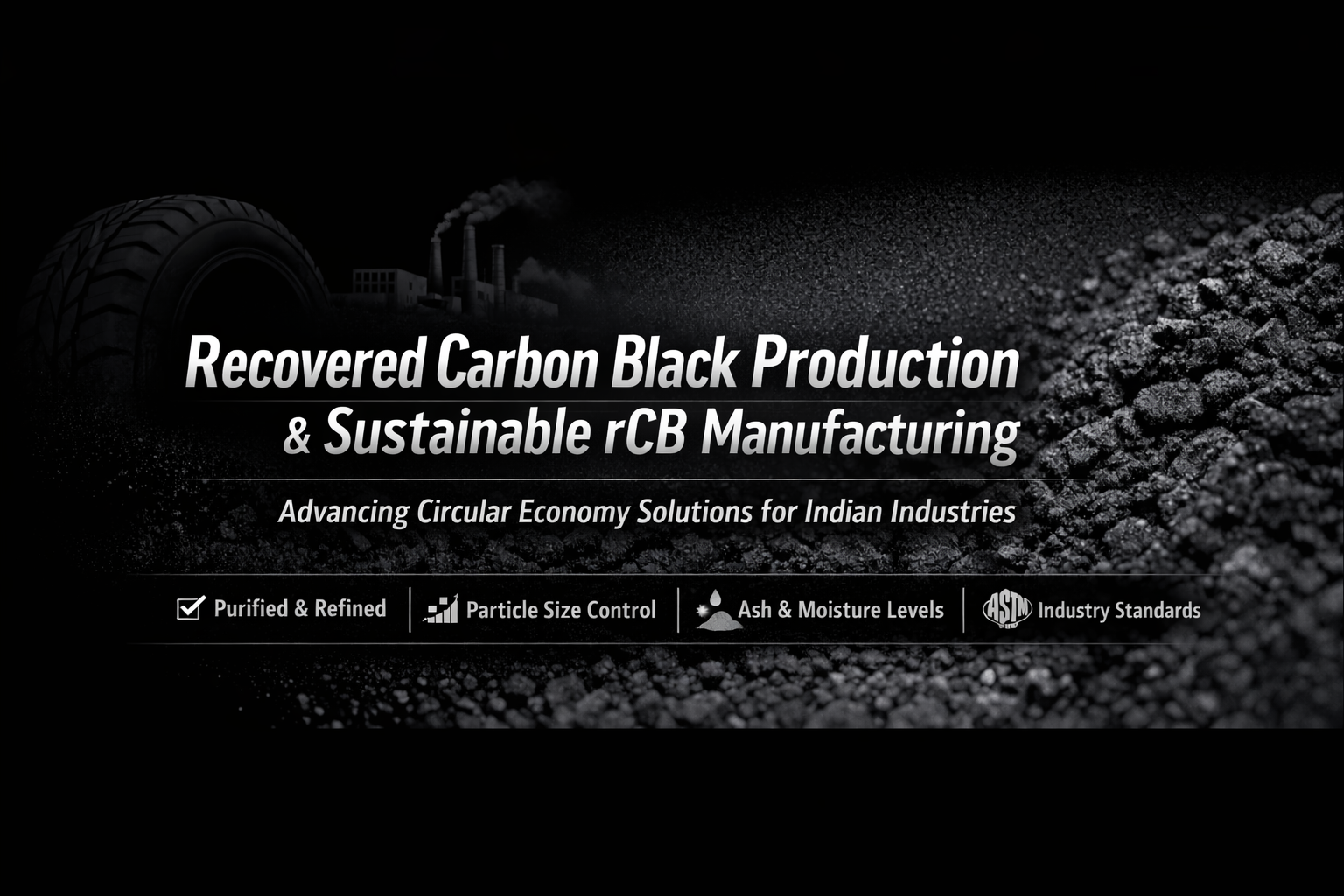
The demand for sustainable raw materials is reshaping manufacturing in India. As industries seek sustainable substitutes to complement virgin carbon black, recovered carbon black (rCB) production has emerged as a game-changing solution—offering reliable performance as a filler material with a significantly lower environmental impact.
But what exactly goes into manufacturing high-quality rCB? And how can businesses ensure they’re sourcing from reliable producers who deliver consistent quality?
What is Recovered Carbon Black and Why Does It Matter?
Recovered carbon black is a sustainable substitute for traditional carbon black, produced by recycling End-of-Life Tyres (ELTs) through advanced thermal processes. Instead of letting millions of tyres end up in landfills or being burned unsafely, the rCB manufacturing process recovers valuable carbon black that can be reused as a high-performance filler across multiple industries.
For manufacturers in rubber, plastics, footwear, paints, and coatings, this means:
- Cost-effective filler material without compromising on product integrity.
- Reduced carbon footprint compared to 100% petroleum-based formulations.
- Compliance with sustainability goals and environmental regulations.
India generates over 5 million tonnes of waste tyres annually. Converting this waste into functional filler materials isn’t just environmentally responsible—it’s economically smart.
The rCB Manufacturing Process: From Waste Tyres to Premium Carbon Black
Understanding the transition from tyre recycling to carbon black production helps manufacturers evaluate supplier quality and production standards.
Step 1 – Collection and Preparation of End-of-Life Tyres
The process begins with sourcing ELTs from authorised collection centres. Tyres are inspected, cleaned, and prepared for processing. Quality rCB manufacturers maintain strict protocols to ensure only suitable tyres enter the production line.
Step 2 – Advanced Pyrolysis Carbon Black Technology
The core of sustainable carbon black production lies in pyrolysis—a controlled thermal depolymerisation process. ELTs are heated in an oxygen-free environment at specific temperatures, breaking down the rubber into its constituent materials:
- Pyro Char (30-35%)
- Pyrolysis oil (40-45%)
- Steel wire (10-15%)
- Syngas (5-10%)
Step 3 – Purification
Raw pyrolysis carbon black undergoes several refinement stages to transform it into a high-grade substitute:
- Magnetic separation removes residual steel particles.
- Milling and micronization achieve desired particle sizes.
- Activation processes enhance surface area and performance characteristics.
Step 4 – Application-Specific Processing
Depending on end-use requirements—whether for rubber compounding, masterbatch production, or paint formulations—rCB undergoes additional treatments to optimize dispersibility, ash content, and surface chemistry.
Key Quality Parameters in Recovered Carbon Black Production
When evaluating rCB manufacturers, focus on these critical specifications that define a high-quality substitute:
- Ash Content: Premium rCB maintains ash content below 12%, with top-tier producers achieving <8%. Lower ash means better performance in final applications.
- Particle Size Distribution: Consistent D50 values (typically 4-5 microns) & D90 (10< microns) ensure predictable processing.
- Moisture Content: Should be below 1\% for optimal storage and processing.
Applications: Where rCB Delivers Performance and Sustainability
- Rubber Industry: rCB serves as a functional filler alongside virgin carbon black in tire manufacturing, conveyor belts, hoses, and molded goods—reducing costs while maintaining physical properties.
- Plastics and Masterbatch: Used as a pigment and UV stabilizer, providing excellent dispersion as a sustainable substitute.
- Paints and Coatings: Provides pigmentation and UV resistance in industrial coatings and automotive paints.
- Footwear Manufacturing: Ideal for outsoles where durability and cost-efficiency as a filler material are paramount.
Why Choose Absolute Green Polymers for Your rCB Requirements
At Absolute Green Polymers Pvt. Ltd., we don’t just produce recovered carbon black—we engineer sustainable filler solutions backed by rigorous quality control.
- State-of-the-Art Production: Our advanced facilities process ELTs with precision.
- Comprehensive Quality Assurance: Multi-stage testing to meet international standards.
- Technical Support: We help your R&D teams integrate rCB as a substitute filler effectively into your existing formulations.
Frequently Asked Questions About Recovered Carbon Black Production
While rCB has different morphology, high-quality rCB from advanced processes performs comparably to N550-N774 grades as a functional substitute in most applications when formulated correctly.
It reduces CO_{2} emissions by approximately 70-80% compared to virgin manufacturing and solves the tyre waste crisis.
Yes. Depending on your application, rCB can be used as a filler material to substitute a portion of virgin carbon black. Our team helps optimize these ratios for your specific needs.
rCB typically offers 15-30% cost savings compared to virgin carbon black, acting as a highly economical substitute.