
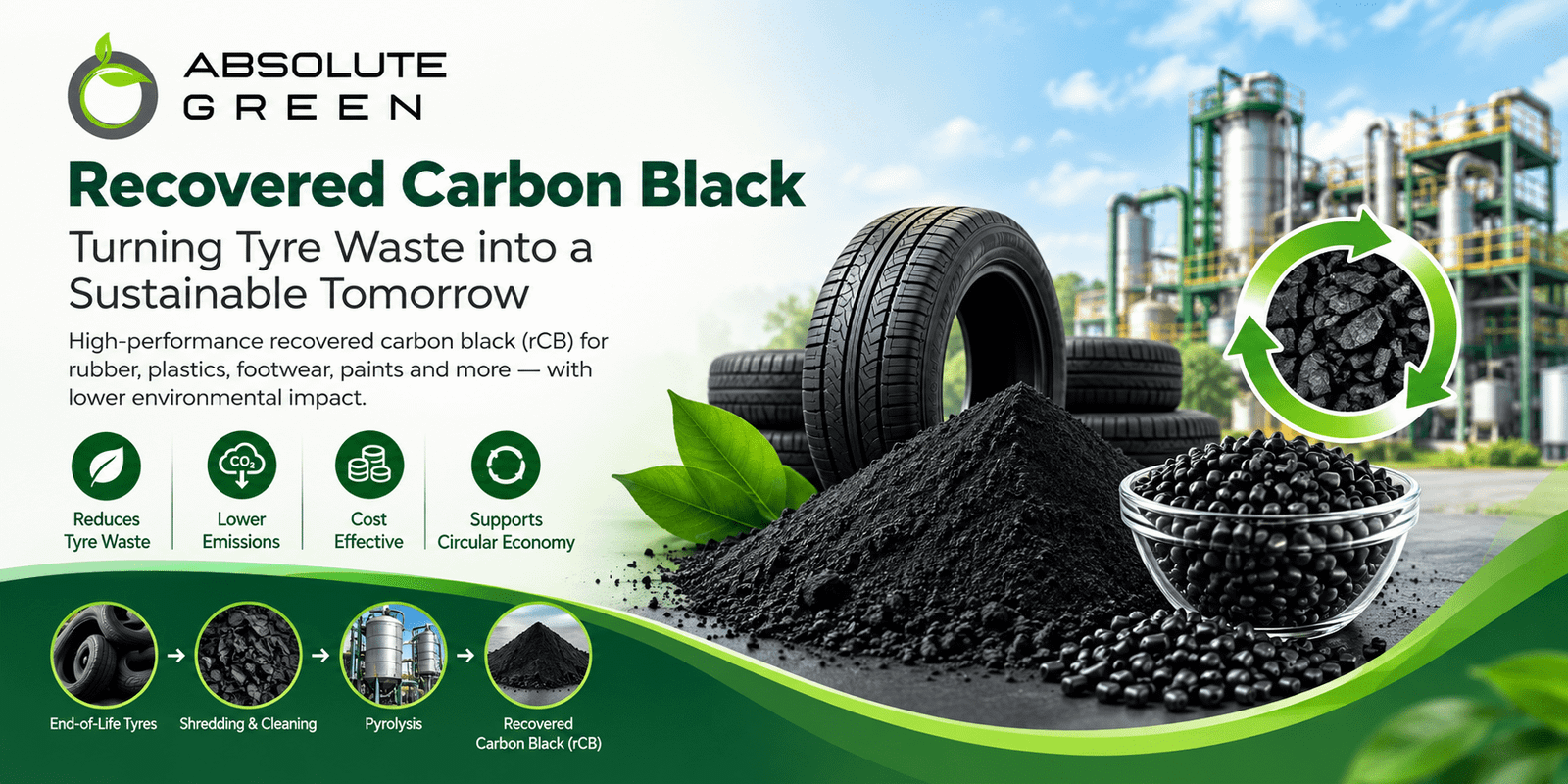
Every year, hundreds of millions of end-of-life tyres are scrapped worldwide — and a large share of them still end up in landfills, illegal stockpiles, or incinerators, releasing pollutants and wasting a material that took significant energy and resources to produce in the first place. Tyre waste is a growing environmental liability for the rubber and automotive industries, and regulators are tightening the pressure to deal with it responsibly.
Recovered carbon black (rCB) is one of the most promising answers to this problem. Instead of letting scrap tyres pile up, manufacturers are now recovering the carbon black locked inside them and reusing it as a high-performance industrial raw material — turning a waste crisis into a supply-chain opportunity.
Quick Answer: Recovered carbon black (rCB) is a sustainable filler material extracted from end-of-life tyres through pyrolysis. It replaces or blends with virgin, petroleum-based carbon black in rubber, plastics, footwear, and paint manufacturing, offering comparable performance with a lower environmental footprint and typically lower raw material cost.
This guide covers what recovered carbon black is, how it’s produced, how it compares to virgin carbon black, and what to look for when choosing a supplier.
What Is Recovered Carbon Black?
Recovered carbon black — also called recycled carbon black — is a sustainable filler material recovered from end-of-life tyres (ELTs) through a process called pyrolysis (also known as depolymerisation). Instead of manufacturing carbon black from petroleum feedstocks, this process thermally breaks down scrap tyres in an oxygen-free environment, recovering carbon black along with pyrolysis oil, gas, and steel.
The result is a fine black powder or pelletized material that performs a similar reinforcing, coloring, and UV-protective role as traditional (virgin) carbon black — but produced from waste tyres instead of fossil fuels. As a proven carbon black alternative, it is increasingly used as an industrial rubber filler across multiple sectors.
In short: rCB takes a waste product (scrap tyres) and turns it into a usable industrial raw material, supporting sustainable tyre recycling and a broader circular economy.
How Is Recovered Carbon Black Made?
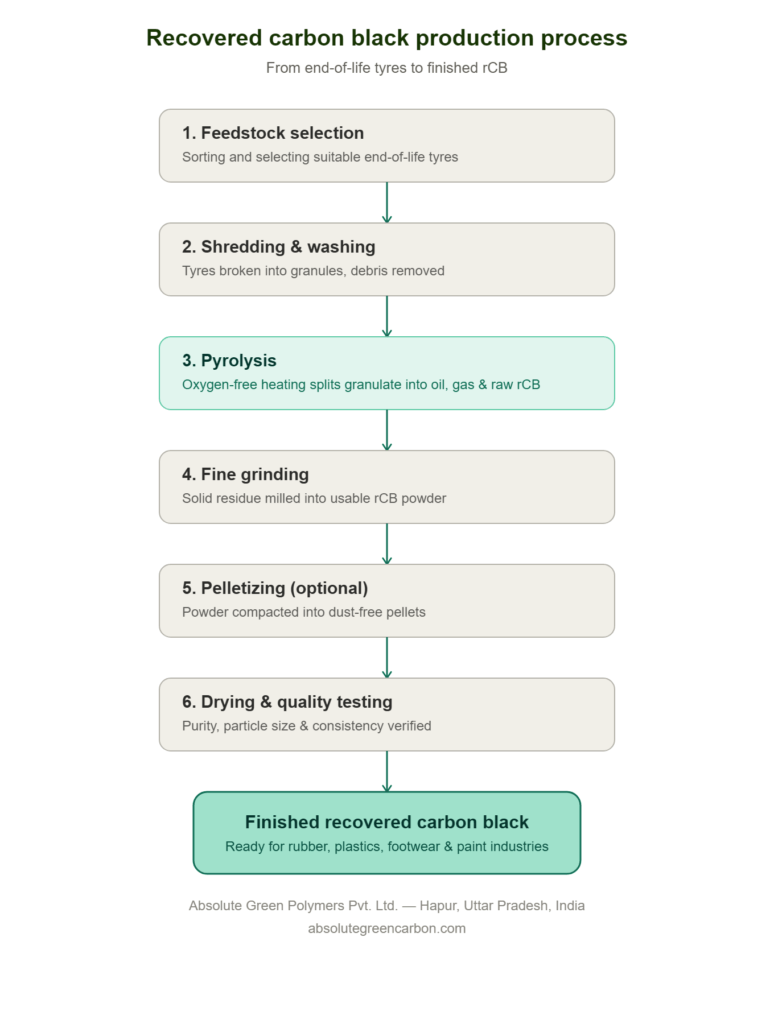
The production process generally follows these steps:
- Feedstock selection — Sorting and selecting suitable end-of-life tyres.
- Shredding and washing — Breaking tyres into granules and removing debris.
- Pyrolysis — Heating the granulate in an oxygen-free chamber, splitting it into oil, gas, and a solid residue (raw rCB).
- Fine grinding — Milling the solid residue into a usable powder.
- Pelletizing (optional) — Compacting the powder into dust-free pellets for easier handling.
- Drying and quality testing — Verifying purity, particle size, and consistency before packaging.
Recovered Carbon Black Market Growth
Demand for recovered carbon black is accelerating fast, driven by tightening emissions regulations and growing adoption of circular-economy practices in tyre and rubber manufacturing.
According to Fortune Business Insights, the global recovered carbon black market was valued at roughly $219 million in 2025 and is forecast to climb to around $3.5 billion by 2034, reflecting a compound annual growth rate near 36% — one of the fastest-growing segments in specialty materials.
- Tyre manufacturing is the largest end-use segment, expected to account for over half of global demand in 2026, as tyre makers look to cut both cost and carbon footprint.
- Non-tyre rubber applications — conveyor belts, hoses, gaskets, and rubber sheeting — represent a growing secondary segment as more manufacturers substitute rCB into existing formulations.
- Growth is being driven largely by the wide availability of end-of-life tyres as feedstock and rising regulatory and customer pressure to adopt recycled, lower-emission materials; the main brake on faster growth is limited processing infrastructure in some regions.
- Asia Pacific, including India, is one of the fastest-growing regional markets as manufacturers scale up local pyrolysis and processing capacity to meet rising domestic and export demand.
Market data source: Fortune Business Insights, Recovered Carbon Black Market Report
Recovered Carbon Black vs. Virgin Carbon Black
| Factor | Recovered Carbon Black (rCB) | Virgin Carbon Black (vCB) |
| Raw material | End-of-life tyres | Petroleum/fossil fuel feedstock |
| Environmental impact | Lower emissions, reduces landfill waste | Higher carbon footprint |
| Cost | Typically more cost-effective | Higher raw material cost |
| Performance | Engineered to match N300–N700 grade equivalents | Industry benchmark |
| Sustainability profile | Supports circular economy and ESG goals | Limited sustainability credentials |
Modern rCB producers use tight process controls to ensure their material performs comparably to virgin carbon black in reinforcement, durability, and consistency — making it a viable drop-in or blended alternative for many formulations.
Key Benefits of Using Recovered Carbon Black
- Cost savings — Manufacturers can see raw material cost reductions of up to 50–60%, depending on the application and blend ratio, compared to virgin carbon black.
- Lower emissions — Producing rCB from waste tyres can generate up to around 10% lower emissions than manufacturing virgin carbon black, depending on the production process and grade.
- Waste diversion — Every tonne of rCB produced means fewer scrap tyres in landfills or stockpiles.
- Consistent industrial performance — Quality-controlled rCB is engineered to match functional performance across N300–N700 grade equivalents.
- Supports ESG and compliance goals — Using rCB helps manufacturers report measurable sustainability progress to customers and regulators.
Which Industries Use Recovered Carbon Black?
rCB has broad applications across several manufacturing sectors — see our full Applications page for detailed use cases:
- Rubber — Conveyor belts, hydraulic hose pipes, LPG rubber tubes, V-belts, cycle tyres, rubber mats and sheets, O-rings and gaskets.
- Plastics — Black masterbatch, HDPE/PVC pipes, LDPE/PP/ABS granules.
- Footwear — EVA granules, EVA sheets, EVA compounds, shoe and slipper soles.
- Paints and coatings — Pigmentation, UV protection, and protective coatings.
Explore the full range of sectors we work with on our Industries We Serve page.
How to Choose a Recovered Carbon Black Supplier
Buyers evaluating rCB suppliers commonly look for:
- Consistent quality — Minimal batch-to-batch variation, backed by a Certificate of Analysis.
- Certifications — ISO 9001 (quality), ISO 14001 (environmental), and ISO 45001 (health & safety) are strong indicators of a mature, reliable operation.
- Sample availability — A supplier willing to dispatch free trial samples quickly (ideally within 48 hours) lets you validate performance before committing to bulk orders.
- Grade compatibility — Confirm the rCB is engineered to match the N300–N700 grade range relevant to your application.
- Packaging and logistics — Clean, moisture-protected packaging (20 kg bags or bulk jumbo bags) reduces handling issues and delays.
- Production capability and location — A supplier with a modern clean-tech facility and reliable pan-India or global shipping reduces supply chain risk.
Browse our full Product range to see available grades, powder and pellet formats, and packaging options.
Why Trust This Guide
This guide is prepared by the Absolute Green Polymers technical team, drawing on our direct manufacturing experience producing recovered carbon black from end-of-life tyres at our clean-tech facility in Hapur, Uttar Pradesh, India.
Our team’s process expertise is backed by ISO 9001:2015 (Quality Management), ISO 14001:2015 (Environmental Management), and ISO 45001:2018 (Occupational Health & Safety) certifications, along with ongoing batch testing to ensure every shipment meets consistent industrial-grade standards. Learn more about our facility and quality processes on our About Us page.
About Absolute Green Polymers
Absolute Green Polymers Pvt. Ltd., based in Hapur, Uttar Pradesh, India, is a leading manufacturer and supplier of recovered carbon black (rCB) produced from end-of-life tyres through advanced depolymerisation technology.
Our rCB is engineered to match the functional performance of conventional virgin carbon black (vCB) across the N300–N700 grade range, and is trusted by manufacturers across the rubber, plastics, footwear, and paint industries throughout India and globally.
What sets us apart:
- Up to 60% cost savings in raw material costs compared to virgin carbon black, depending on the application
- Up to nearly 10% emission reduction compared to virgin carbon black production, depending on the process
- Consistent, machine-safe quality with no batch-to-batch variation
- Modern clean-tech production facility with strict quality control
- Certified to ISO 9001:2015, ISO 14001:2015, and ISO 45001:2018
- 48-hour sample dispatch so you can test performance before ordering
- Clean, moisture-protected packaging (20 kg bags and bulk jumbo bags)
- Reliable delivery across India and internationally
See our full product line on the Products page, or reach out directly via our Contact page.
Frequently Asked Questions
Q1. What is recovered carbon black (rCB)?
Recovered carbon black is a sustainable material made from end-of-life tyres through pyrolysis (depolymerisation), used as an eco-friendly, cost-effective carbon black alternative in rubber, plastics, and other industrial applications.
Q2. Is recovered carbon black as good as virgin carbon black?
Quality rCB, produced with strict process controls, is engineered to match the functional performance of virgin carbon black across common grade equivalents (N300–N700), making it a reliable substitute or blend component in many formulations.
Q3. How much can I save by switching to rCB?
Manufacturers commonly report raw material cost savings of up to 50–60%, depending on the application, when switching from virgin carbon black to a quality-controlled recovered carbon black supply.
Q4. Can I request a sample before placing a bulk order?
Yes — reputable rCB suppliers, including Absolute Green Polymers, offer trial samples with fast dispatch (typically within 48 hours) so you can validate performance in your own production process first.
Q5. Where is recovered carbon black manufactured in India?
Absolute Green Polymers manufactures recovered carbon black at its clean-tech facility in Hapur, Uttar Pradesh, and supplies customers across India and internationally.
Q6. How big is the recovered carbon black market?
According to Fortune Business Insights, the global recovered carbon black market was valued at roughly $219 million in 2025 and is projected to reach approximately $3.5 billion by 2034, growing at a CAGR of around 36%, driven primarily by demand from tyre and non-tyre rubber manufacturers.


