Turning Old Tires into New Resources.
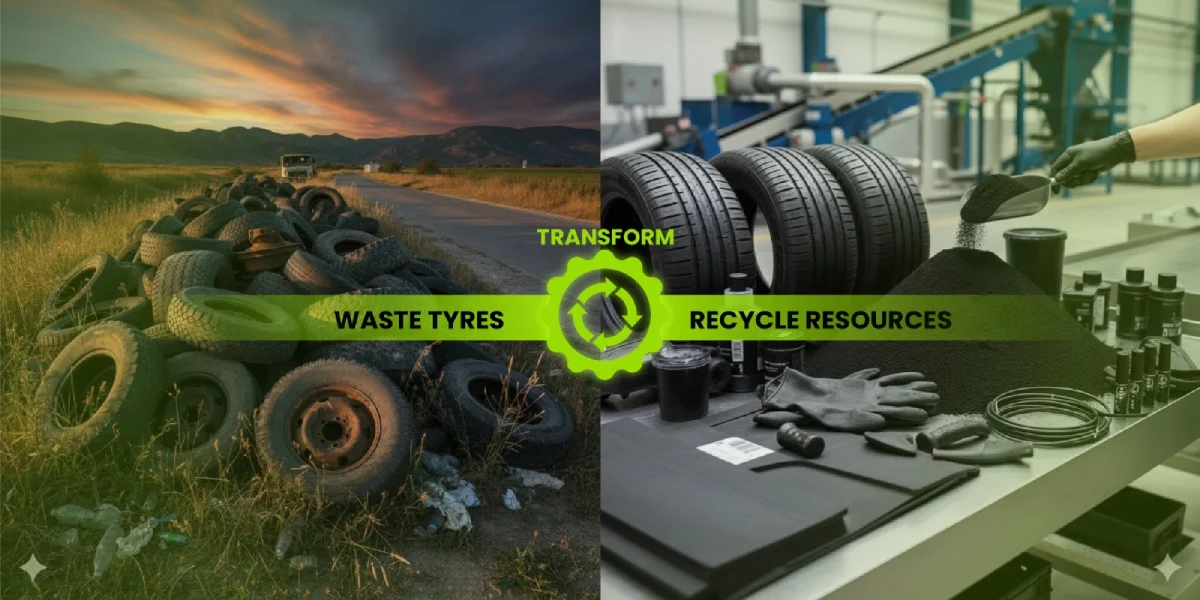
The global challenge posed by End-of-Life Tires (ELTs) is monumental. Annually, one billion tires are discarded globally, thus creating an urgent environmental and logistical dilemma. This is causing a major black pollution threat from landfills. The circular economy is shifting this paradigm, seeing ELTs as valuable raw materials. A primary technology, pyrolysis, is being successfully employed to recycle tire waste into recovered carbon black (rCB) that acts as a sustainable alternative to virgin carbon black (vCB) in some of the manufacturing industries. Let’s discuss this revolutionary solution.
Pyrolysis: Unlocking Carbon Black from the Core of the Tire
What is Pyrolysis?
Pyrolysis is a high-temperature chemical process. It’s used to break down organic materials, like rubber in End-of-Life Tires (ELTs), in a reactor vessel under an inert, oxygen-free atmosphere, either using whole or shredded tires. This breaks down the complex polymer into various components. It’s complex and superior to simple combustion.
For Absolute Green Polymers, the superior process involves a critical pre-treatment step that ensures the quality of all output materials.
The Outcome Consists of Four Key Products:
- Recovered Carbon Black (rCB) – from Pyro Char: The direct solid output of the pyrolysis reactor is a solid residue called Pyro Char (or tire char). This char, which typically constitutes 30-40% of the original tire mass by weight, is then transformed into high-quality recovered Carbon Black (rCB) using advanced grinding technology. This final rCB is the fine, usable material that serves as a sustainable vCB substitute.
- Tire Pyrolysis Oil (TPO): TPO is the primary liquid product, a complex mix of hydrocarbons that can be immediately used as a substitute industrial fuel due to its high caloric value.
- Steel Wire (Unburnt and Shining): Unlike many conventional pyrolysis processes, our method involves mechanically crushing the tire and extracting the steel wire before the tire material enters the pyrolysis reactor. This critical step ensures the steel wire is not burnt and remains shining and intact. It is easily separated and can be directly recycled by the steel industry without compromising quality.
- Syngas (Synthetic Gas): This non-condensable fraction is a fuel gas primarily composed of hydrogen, carbon monoxide, and light hydrocarbons. Crucially, Syngas is channeled back into the pyrolysis plant to fuel the reactor itself, significantly reducing the facility’s reliance on external energy and lowering the overall carbon footprint.
It’s a closed loop of circular economy where the entire waste stream is utilized, eliminating landfill disposal.
The Rise of rCB: A Sustainable Alternative
rCB serves as a promising sustainable substitute for Virgin Carbon Black (vCB). The production of vCB heavily relies on burning fossil fuels, consuming huge amounts of energy, and releasing emissions of 35-40 million tons of $\text{CO}_2$ per year, along with the release of polycyclic aromatic hydrocarbons (PAHs).
rCB offers a path to reduce both fossil fuel consumption and carbon emissions. A two-way win for both humans and the environment.
The global recovered carbon black market is witnessing rapid growth, which is projected to expand at a Compound Annual Growth Rate (CAGR) of over 16.4% from 2025 to 2032.
This growth is rising thanks to corporate sustainability goals and consumers’ increasing preference for eco-friendly materials in their products.
Applications: While rCB’s primary application remains the tire industry, it is gaining popularity in various sectors like plastics, rubber, paint coatings, and inks.
Absolute Green Polymers: Driving India’s Circular Leap with rCB
India is rapidly emerging as a crucial player in the End-of-Life Tyre (ELT) recycling space, driven by increasing regulatory focus and robust growth in various sectors. This creates immense potential for both production and consumption of recycled materials.
The recovered carbon black (rCB) sector is gaining traction, with Absolute Green Polymers establishing a significant footprint. Positioned as one of the leading carbon black manufacturers in India, Absolute Green Polymers is ISO certified for Quality Management, Environmental Management, and Occupational Health & Safety. The company precisely focuses on high-quality grade rCB for international and domestic markets.
Absolute Green Polymers supplies manufacturers in rubber, plastics, and more with high-performance, sustainable materials that are both effective and eco-friendly. This leadership role supports the local economy and plays a critical part in reducing India’s dependence on imported virgin carbon black and raw rubber materials.
Conclusion: The Circular Solution for End-of-Life Tires
The challenge posed by End-of-Life Tires (ELTs) is complex, but the resulting solutions are robust and strategic.
Tire pyrolysis, coupled with advanced processes like pre-pyrolysis steel extraction and post-pyrolysis char refinement, is an essential technology. This refined process generates high-performance recovered Carbon Black (rCB) and premium recycled steel, effectively restoring the utility of the original polymer components. This is a critical step in the recycling equation.
These advanced technologies move the industry past simple downcycling. They provide premium, sustainable materials that directly re-enter the production cycle for new tires and rubber goods. The growth of specialized rCB manufacturers in India signals more than just better waste management; it’s a crucial enabler for sustainable mobility and a genuinely circular tire industry.