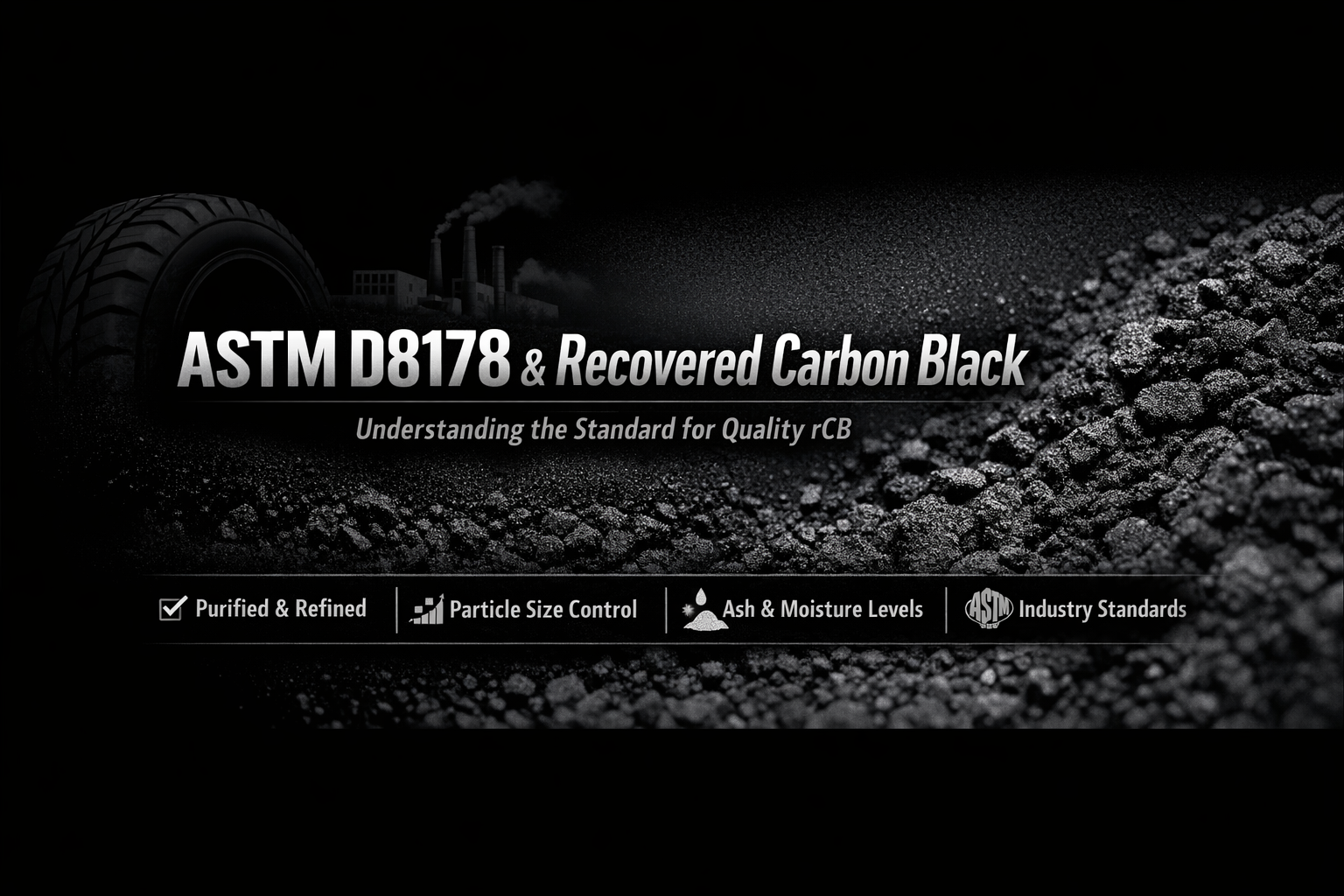
If you are exploring Recovered Carbon Black (rCB) as a sustainable addition to your manufacturing process, the first question is not how to test it—but what actually qualifies as rCB and whether it is fit for industrial use. This is exactly where ASTM D8178 comes in.
ASTM D8178 is a terminology and classification standard created specifically for the industry. Its primary role is to define recovered carbon black clearly, separate it from low-value pyrolysis char, and give buyers a common language to evaluate rCB quality across suppliers. For companies like Absolute Green Polymers, this standard is the foundation of transparency.
What ASTM D8178 Actually Defines
ASTM D8178 provides a standardized framework for the classification, properties, and terminology of rCB. It answers the critical question: When can a tire-derived carbon material legally and technically be called “Recovered Carbon Black”?
According to the standard, for a material to qualify as rCB, it must be:
- Freed from steel and textile fibers.
- Refined and milled to specific particle sizes.
- Categorized based on defined properties like surface area, particle size, and ash content.
If these conditions are not met, the material remains pyrolysis char, not rCB. This distinction is crucial for manufacturers who rely on predictable performance.
Technical Framework: Key Properties of rCB
ASTM D8178 outlines the key properties that determine rCB’s suitability for industrial applications. Buyers use these metrics to verify quality:
- Surface Area: Influences reinforcement and processing behavior (Referenced via ASTM D6556).
- Particle Size Distribution: Affects performance and dispersion in rubber and plastic applications.
- Ash Content: Typically 10–20% in rCB. This impacts purity and performance, distinguishing it from virgin grades (Referenced via ASTM D1508).
- Moisture Content: Essential for ensuring proper handling and preventing processing defects.
- Oxygen Content: Impacts surface chemistry and the reactivity of the material.
rCB vs. Pyrolysis C1har: Why the Difference Matters
Many suppliers loosely market tire-derived carbon as “rCB,” but ASTM D8178 draws a hard line. Here is the practical difference for the buyer:
| Feature | Pyrolysis Char (Raw) | Recovered Carbon Black (rCB) |
| Processing | Raw output from tire pyrolysis. | Cleaned, refined, and milled material. |
| Consistency | High contamination, inconsistent size. | Controlled, semi-reinforcing properties. |
| Standards | Unregulated waste byproduct. | Classified by ASTM D8178 properties. |
| Usability | Limited industrial usability. | Suitable for rubber, plastics, and fillers. |
Why rCB is a Functional Filler, Not a vCB Replacement
ASTM D8178 acknowledges a simple reality: Recovered carbon black is fundamentally different from virgin carbon black (vCB). At Absolute Green Polymers, we treat rCB as a functional filler or substitute, not a 1:1 replacement.
This distinction is vital because rCB includes:
- Inorganic components such as zinc, silica, and calcium from the original tire.
- Higher ash content than virgin CB.
- Unique particle structures that offer different reinforcement levels.
Because of this, rCB cannot be evaluated using vCB benchmarks alone. ASTM D8178 establishes a framework that reflects real-world rCB behavior.
How Buyers Use ASTM D8178 (Without Becoming Testing Experts)
From a buyer’s perspective, ASTM D8178 is a trust tool. You use it to:
- Confirm Identity: Ensure you are buying refined rCB, not raw char.
- Standardize Sourcing: Compare suppliers using technical definitions rather than marketing claims.
- Ensure Process Quality: Verify that the material has been milled and classified according to the industry-standard properties mentioned above.
While D8178 defines the language, it allows you to reference other specific ASTM standards (like D6556 or D1508) to evaluate the exact performance of a specific batch.
Final Thoughts: Protecting Your Product Integrity
ASTM D8178 exists to protect you. It ensures that when you invest in circular materials, you are getting an industrial-grade product that performs predictably across batches.
At Absolute Green Polymers, our recovered carbon black is produced, refined, and supplied in strict alignment with ASTM D8178 definitions and classifications. By focusing on definition, consistency, and standardized properties, we ensure your transition to sustainable fillers is seamless and reliable.