Choosing between Recovered Carbon Black (rCB) powder and pellets shouldn’t feel like a high-stakes guessing game. Since we provide both forms, we’ve seen firsthand that the “best” choice isn’t about which one is superior, it’s about which one fits your specific factory floor, your machinery, and your final product.
Think of it like choosing between ground coffee and coffee beans. Both make a great cup, but how you brew them depends on the equipment you have in your kitchen.
Here is the unbiased breakdown to help you decide which form of rCB is right for your product.
The Powder: The Quick Dissolver
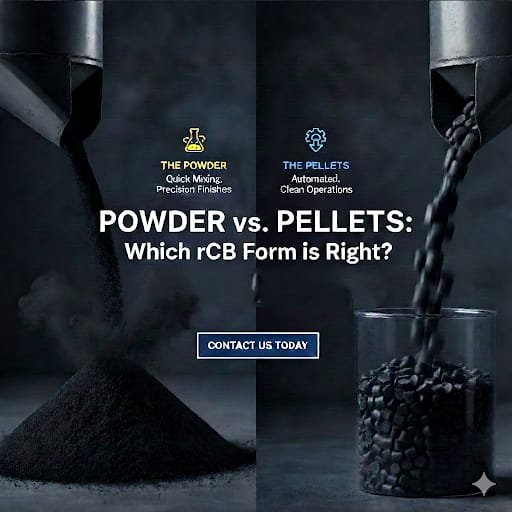
rCB powder is the “raw” form as it’s fine, fluffy, and ready to react. It’s perfect for processes where speed and surface area are everything.
- The Big Pro: Fast Mixing. Because the particles are already fine, they disperse almost instantly in liquids or resins. If you’re making high-end inks, coatings, or thin films, powder ensures you won’t have tiny “nibs” or clumps in your finish.
- The Trade-off: The “Black Cloud.” Powder is light. Really light. If you open a bag too fast, a bit of it will inevitably end up on the floor (or your workers’ coveralls). It requires a bit more care with dust extraction and PPE.
- Best for: rCB powder works best for custom mixes because it’s affordable and free from extra chemicals or additives.
The Pellets: The Smooth Operator
Pelletized rCB is just the powder compressed into small, sturdy beads. It’s designed for industrial-scale efficiency and a cleaner workspace.
- The Big Pro: Total Control. Pellets flow like water through automated feeders and silos. They don’t clog up in the hopper, and they create almost zero dust. This makes your EHS (Safety) Officer delighted and keeps your plant looking pristine.
- The Trade-off: The “Crush” Factor. To get the carbon into your product, your mixer has to physically break the pellets back down. While heavy-duty equipment (like a Banbury mixer) does this easily, lighter mixers might need a bit more time to get a smooth blend.
- Best for: High-volume manufacturing, automated plants, and industries like rubber goods where cleanliness and “set-it-and-forget-it” feeding are priorities.
Quick Comparison Table
| If you care about… | Go with Powder | Go with Pellets |
| Speed of Dispersion | Ultra-fast | Comparatively Low |
| Plant Cleanliness | Regular dusting required | Less Dusty |
| Storage Space | Takes up more room | Very compact |
| Feeding Method | Manual / Hand-scooped | Automated / Silo-fed |
A Quick Myth-Buster
One question we get a lot: Does pelletizing change the quality of the carbon?
The simple answer: No.
The chemical “soul” of the rCB, the Ash content and Volatile Matter remains exactly the same. Pelletizing is a physical change, not a chemical one. You get the same performance regardless of the shape.
The Final Verdict
- If your priority is precision and instant dispersion in high-end finishes, Powder is your partner.
- If your priority is operational efficiency, EHS compliance, and automation, Pellets are your go to option.
Still not sure which one your machinery prefers? We can send you a small sample batch of both so your production team can run a trial. Would you like us to arrange that for you?
Contact us today & let’s grow together.